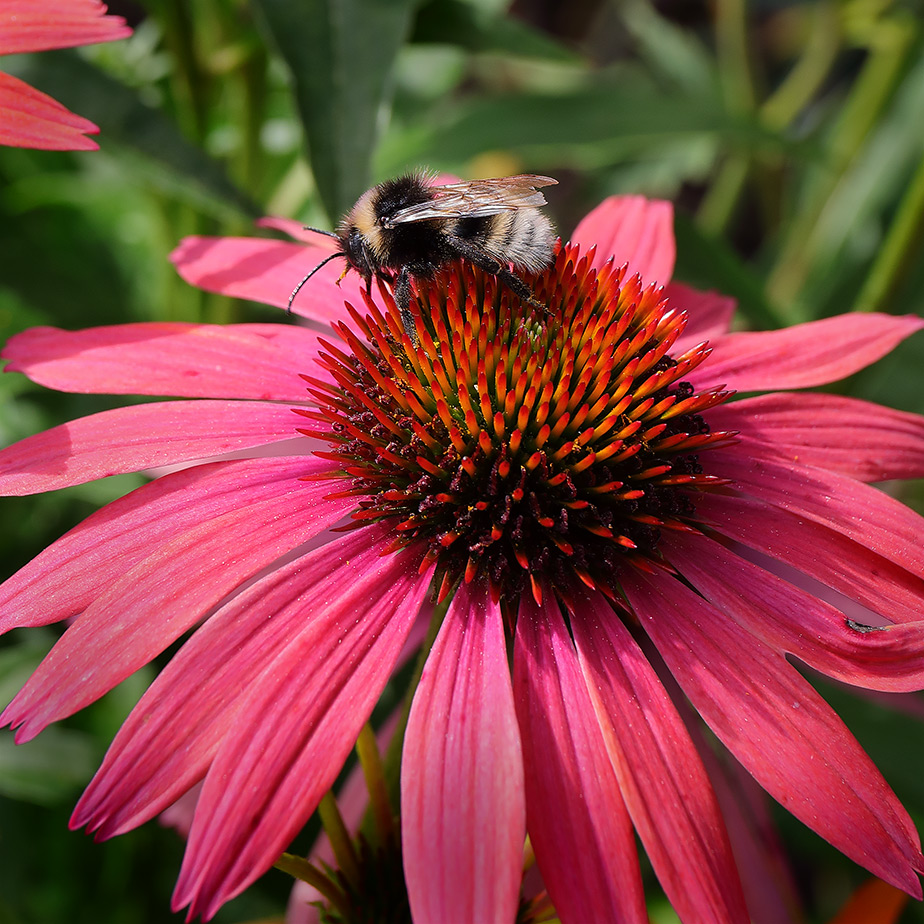
NB: A note for WordPress Reader users – you need to click on the title of the post again to see the full photograph. (Otherwise you see just a tiny section!)
This year was a worrying one as far as tiny visitors to the garden went. In spring and early summer it definitely felt as if there were fewer bees and other pollinators around. Butterflies, too, seemed scarcer this year. Things improved in the later part of the summer and there were days when there were a fair number of insects around, but not as good as previous years.
Last winter was a very cold one, with much harder frosts than we usually get. Presumably, this must have made it harder for hibernating insects to make it through to spring. I’ve also read that last year’s drought didn’t help insect numbers. Hopefully the wetter summer this year will have produced an improvement.

It was a relief to see bees and butterflies appearing as the summer progressed. But there were some things that I didn’t see here, such as the Small Tortoiseshell butterfly in the photo below.
Peacock butterflies were a rare sight here too, but Red Admirals appeared in good numbers. (They are the commonest butterflies in my garden, along with the Cabbage Whites.) The largest number I saw was on a particularly sunny day, when about a dozen Red Admirals and a solitary Peacock were feasting on a buddleia. For a few warm days there were enough of them around to swirl past me whenever I walked along the path and brushed against our butterfly bushes.

There was an increase in dragonflies visiting – they have obviously become more aware of our pond. It was amusing to watch these fairly heavy creatures try to settle on the nearby stems of evening primrose, which quickly bent and swayed under their weight. To give them better lookout posts, I pushed some big birch twigs into the pots of a couple of the pond plants. I hope they appreciated them!
Although this appeared to be a poor year for insects, there are some signs of hope in the attitudes towards their welfare. I’ve noticed a lot more wild plants and food plants for bees and butterflies in garden centres and nurseries, a response to the growing interest in gardening for wildlife. And, much to my delight, our local council stopped mowing many grassy areas. This means that the green that runs in front of the houses here is being allowed to become wilder. I’m hoping that in a few years we’ll have a decent little wildlife meadow out there!


 Ann Mackay: Inspired by Nature
It’s always a pleasure to see hoverflies, and you got a good picture of this one. The red admiral butterfly is common in Texas, too; it’s quite a world traveler.
Some residents will complain about anything not kept shorn to within two centimeters of the ground, so let’s hope your local council sticks to its plan of not mowing the grassy areas you mentioned.
And let’s also hope you can confirm that some dragonflies have taken advantage of the twigs you set out for them.
LikeLiked by 2 people
I made a point of contacting our council to let them know how happy I was with how they were leaving the grass uncut and encouraging the green here to become a wildflower meadow. They had had a couple of complaints about the uncut grass but they’d had good responses too. (So I’ll be doing my best to encourage them again next year!)
LikeLiked by 1 person
Hurray – you did it! Looks lovely too.
LikeLiked by 2 people
Thank you! It was a relief to see that everything still worked! 🙂
LikeLiked by 1 person
After a truly terrible start, insect numbers seemed to pick up here in late summer. I love your shot of the hoverfly, which reveals details that are impossible to spot when they’re on the wing.
LikeLiked by 2 people
Yes, it was much the same here…insect numbers got better by late summer. There didn’t seem to be a great number about, which is a worry. Perhaps as the new ‘meadow’ develops out the front, there will be more insects drawn here by it and they’ll be able to make use of my garden too.
LikeLiked by 1 person
There’s an interesting read regarding the result from this year’s big butterfly count…
https://butterfly-conservation.org/news-and-blog/butterfly-numbers-increased-this-summer
I was also delighted to have a White Admiral visit my garden this year, unusual for this area in Lincolnshire.
LikeLiked by 2 people
Thanks for the link Mik! That was really interesting and encouraging too. I shall continue to try to plant my garden to suit bees, butterflies and other insects and hope that the weather is kind… 🙂
LikeLike
And I forgot to say – how exciting to have a White Admiral visiting your garden – I’ve never seen one of those!
LikeLike
Perspective may not be everything, but it does make a difference. Thanks to our drought, there have been almost no mosquitos around: good for humans, but not so good for swallows, dragonflies, and bats. The good news is that those creatures can fly off to wetter areas. Putting those sturdy stems in your pots was a good idea. I often see dragonflies perched on the end of sticks. A lot of people dislike taking photos of them that way — like the ‘bird on a stick’ photos that get criticized — but it’s obviously their preference, so why not?
There are certain cemeteries around Texas where boards constantly are refereeing battles between “bring on the flowers” and “mow it all down” camps. One trick the flower-lovers have learned is promoting spring blooms as tourist attractions. Even mowers can be persuaded when increases in motel occupancy and retail sales can be correlated with the coming of the bluebonnets!
LikeLiked by 2 people
Somehow I never seem to have my camera handy when there’s a dragonfly visiting – I shall have to lie in wait for one…
Great idea to promote the flowers as tourist attractions. That will help to get the mowers onside!
LikeLiked by 1 person
Our spring started similarly as far as insects go but once things warmed up the numbers grew. We might have had too much rain but once it stopped the insects seemed to thrive for a change. It was one of the best years for bugs in the yard or at least seemed so. I hope yours bounce back next year.
LikeLiked by 2 people
I’m always hopeful Steve, and the article linked by Mik in the comments here suggests that things may be better than they appeared to be. Meanwhile I’m considering what else I can grow to help insects.
LikeLiked by 2 people
Great pictures of your late visitors, Ann! It is a good gesture to garden for wildlife!!
LikeLiked by 2 people
Thanks Indira! Gardening for wildlife is just a tiny way of trying to help and makes a difference when a lot of gardeners do it. 🙂
LikeLiked by 2 people
Nice to see the insect life. Small Tortoiseshells are common here, but Red Admirals are less so. Was nice to see one recently.
LikeLiked by 1 person
Interesting to know that you get more of the Small Tortoiseshells, Jill. They are much rarer here, while we usually have lots of Red Admirals. Shows how different areas of the country vary.
LikeLike
Quite true. We get a fair few Orange tips as well but never ever seen blue butterflies up here.
LikeLiked by 1 person
I have never seen an orange tip but I have sometimes seen a blue butterfly here. (A Holly Blue I think.)
LikeLike
Hi Ann – hopefully I have fixed my Firefox mess. Love the images as usual. We have had much fewer butterflies (Monarchs and Palamedes Swallowtails) here in Florida – sort of a trend I have seen over the last couple years. We do have dragonflies, and they are the huge gangly kind, and they scare me. They add a real Halloween feel around here! HaHa! Still have my big bee buddies at least.
LikeLiked by 1 person
Hi, I’m assuming it’s Syd! (You’re coming up as ‘Someone’!) I gave up on Firefox a few years ago and swapped over to Chrome, which seems to work better.
I think wildlife everywhere is having difficulties – so much erosion of habitat and climate change too. I know what you mean about the big dragonflies – they are a bit like mini helicopters or something in the way they fly around so fast – but they amuse me. Glad you still have bees around. 🙂
LikeLike
Great photos.
LikeLiked by 1 person
Thank you! I enjoy watching bees and others in the flowers. 🙂
LikeLiked by 1 person
It is good news that your council decided to leave some grassy patches alone. We know how
important wild and natural areas areas are yet continue to groom to make things look “orderly.”
I hope your insect numbers will keep improving. The portraits of the visitors to your garden are exquisite–it’s lovely to see so many details up close.
LikeLiked by 1 person
Thank you Tanja! There are other visitors that I have yet to manage to photograph – either I don’t have my camera handy or they’re just too quick for me! (But I love just catching a glimpse of new visitors!)
LikeLiked by 1 person
I can relate. But it’s ok if we can’t snap a photo of everything that intrigues us.
LikeLiked by 1 person
Exquisite photo of the tortoiseshell. I’ve just discovered your blog (WP recommended it at the bottom of one of mine) and I love your gorgeous nature and pollinator photography. It’s wonderful to have this community of people who care so much about pollinator habitat around the world. I look forward to seeing more of your posts. -lisa
LikeLiked by 1 person
Thank you Lisa! Your lovely comment has made me smile. There is a great community of like-minded bloggers here, which is a large part of why I enjoy blogging. I hope you enjoy reading my posts! (I’m off to have a look at your blog now… 🙂 )
LikeLiked by 1 person