
NB: A note for WordPress Reader users – you need to click on the title of the post again to see the full photograph. (Otherwise you see just a tiny section!)
Clematis are amongst my favourite flowers – probably pretty close to the top of the list. The large-flowered varieties are sumptuous, with rich colours and beautiful flower forms. I’m always tempted to grow more of these wonderful plants. But the smaller-flowered cultivars are just as appealing. They may also be easier to fit into a wide variety of garden styles.
The large-flowered clematis can sometimes feel too showy for a more naturalistic planting style, or in a wilder part of a garden. Here the smaller-flowered clematis may be easier to use, sitting more comfortably with simpler, less highly-bred flowers. I can easily imagine the lovely little clematis in my top photograph growing through shrubs in my own garden. (I’d need to find out what it is first. This is a plant I saw in a garden I visited this year, as is the pink clematis below.)
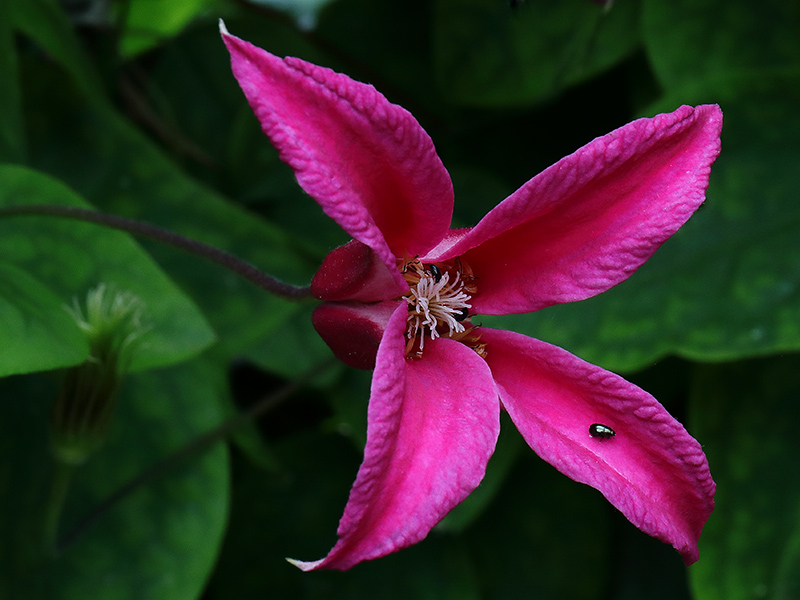
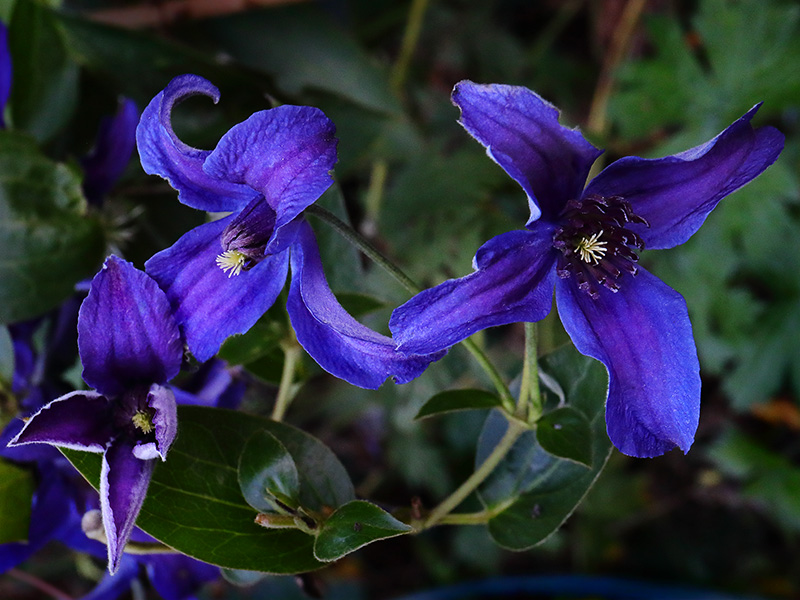
The pink clematis would need a bit of thought about positioning because it is such an eye-catching colour. It is very elegant, though, and wouldn’t look out of place in an informal planting. The deep blue/purple clematis below would probably look good almost anywhere. This one is ‘Sapphire Indigo’, bought many years ago at a plant fair. I haven’t seen it for sale anywhere since (although it is available online), which surprises me. It’s a lovely plant which sprawls rather than climbs, so I prop it up by leaning it against the branches of nearby shrubs. I should try to propagate it because I’d love to have more of it around the garden.
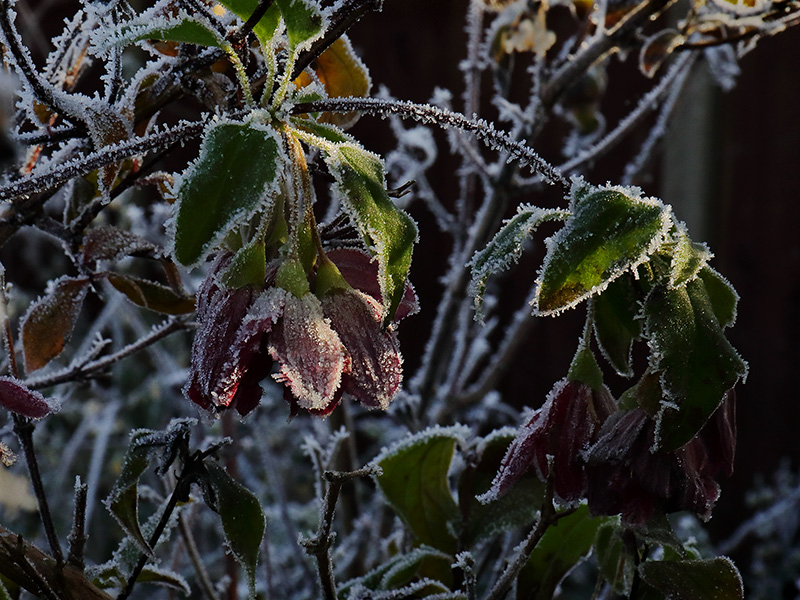
The last clematis in this little gathering is ‘Lansdowne Gem’, which flowers in wintertime. It got thoroughly frosted last winter, which worried me a bit because I wasn’t sure if it would be hardy enough to cope with a long cold period. It does appear to have survived though, because I can see some new shoots appearing now. (Mine goes dormant in the heat of summer, so only starts to show signs of life around this time.) This is a pretty clematis, with dark red, occasionally speckled, flowers that are like little bells hanging down from the shrubs it climbs. Its flowers are something cheering to look forward to in the depths of winter.
(You can see more pictures in my post about ‘Lansdowne Gem’ here.)

 Ann Mackay: Inspired by Nature
Do all of the species you’ve shown here do the typical feathery Clematis thing when they go to seed? If so, are any especially attractive at that stage?
LikeLiked by 1 person
I can’t say for the two that were in other folk’s gardens, but the clematis in mine vary. Some are just rather fluffy rather than feathery. (‘Guernsey Cream’ is probably the most feathery of mine. And that’s not spectacular.) I often remove the seed heads before they’ve developed in the hope of having more flowers.
LikeLike
In Austin, by far the most common species is Clematis drummondii, whose flowers are small but whose seed heads develop fibers that are at first shiny and then become feathery. For that reason, most people’s attention goes to the post-floral stages. If our local species had large, colorful flowers like the ones you’ve shown, we’d be paying a lot more attention to the floral stage.
LikeLiked by 1 person
The shiny stage of the fibres is very attractive – after that ours can look a bit tatty (disheveled). Imagine how it would be if native clematis had big flowers – could look quite riotous if there were too many different one together, hehe!
LikeLike
Sapphire Indigo is AWESOME!!!
LikeLiked by 1 person
Hehe, I agree, Liz! it’s one of my absolute favourites because of the colouring. 🙂
LikeLike
I sure can see our Clematis pitcheri behind your Sapphire Indigo, and although I wouldn’t have thought of it, I suspect you’re right about C. texensis behind (underlying? what’s the right word?) your Princess Diana. I like the addition of the little insect on that one, being worn like a brooch!
LikeLiked by 1 person
It is like a little brooch, hehe! Actually a pollen beetle – we get lots of the at times. 🙂
LikeLiked by 1 person
Rich colours, Ann…gorgeous flower!
LikeLiked by 1 person
Thank you Indira! I love the colours of clematis…deep and rich!
LikeLiked by 1 person
They are all like jewels and the Princess Diana picture has the added gem of a shiny little beetle. My neighbour has a clematis somewhere up his greenhouse which should be mingling with his bright green fake plastic garland he’s put up alongside 😫
LikeLiked by 1 person
My favourite kind of jewels! I hope your neighbour decides to have another clematis alongside the first instead of the plastic garland…or maybe it will just mysteriously disappear, hehe!
LikeLike
He is a bit random that way. He probably fastened it up there to cover a bare bit so hopefully he will do one of three things: buy and plant another climber and remove the horrid plastic thing, wait till his clematis grows then remove the horrid plastic thing. Said horrid plastic thing will inevitably turn blue, look even more horrid and he’ll pull it down. I live in hope 😂
LikeLiked by 1 person
Your first picture and the frosty one are wonderfully atmospheric, in very different ways.
LikeLiked by 1 person
Thank you! The days certainly felt very different to each other!
LikeLike
Spectacular colored Clematis blossoms, Ann! Thank you for sharing.
LikeLiked by 1 person
Thank you! I do love the vibrant colours of clematis – it would be tempting to fill the garden with them!
LikeLiked by 1 person
My vote would be for small-flowered clematis in pink and indigo, if they exist in those colours. 🙂
LikeLiked by 1 person
Oh, that would be lovely! There are so many cultivars that there just might be…. 🙂
LikeLiked by 1 person
If you find any, please let me know. 🙂
LikeLiked by 1 person
I’d love to find one!
LikeLiked by 1 person