
NB: A note for WordPress Reader users – you need to click on the title of the post again to see the full photograph. (Otherwise you see just a tiny section!)
Officially it’s autumn, but summer is determined to cling on here. Temperatures are breaking records for this time of year (over 30C for several days). So it feels appropriate to post a collection of bold yellows this week, a colour that makes me think of a child’s drawing of the sun.
The yellow lily demanded my attention as it gleamed in the sunlight and flaunted its brilliant colour against a dark background. It, and most of the other flowers here, were photographed during garden visits. (This spectacular lily was photographed at Fullers Mill, which I have posted about several times: here, another here, and again here.)
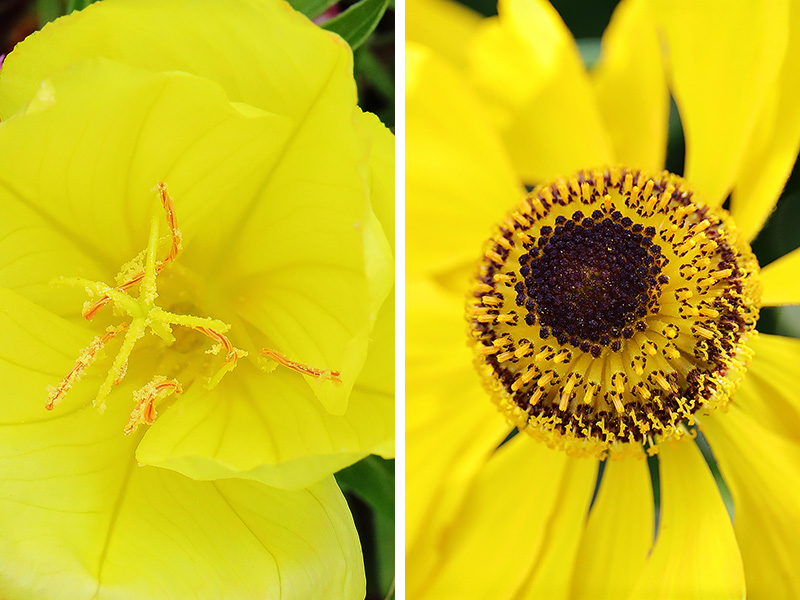
The helenium (above, right) and the Anthemis daisies (below) were also photographed in other people’s gardens. I’ve visited a lot of gardens this year, making up for previous years when Covid caused the cancellation of many garden-openings. It has been a lot of fun and a great way to see plants I don’t grow here, many new to me.
The evening primrose shown above is the one flower here that was photographed in my own garden. It is Oenothera macrocarpa (Missouri evening primrose, bigfruit evening primrose), a low-growing perennial that sprawls happily in the dry soil here. The flowers of this evening primrose are a bit darker and a more lemony yellow than the taller evening primroses that also grow well here. Their flowers are larger too, opening in the afternoon and persisting well into the next morning before fading.
The last plant in this post, Anthemis tinctoria, is one that also grows in my own garden. Mine, however, is ‘E.C. Buxton’, which has much paler petals (actually ray florets). I don’t know what the cultivar in the photo here is, but I was impressed by the richness of its colour. Just the thing for a post inspired by sunshine!


 Ann Mackay: Inspired by Nature
I love the color of yellow flowers, anything yellow.
LikeLiked by 2 people
Me too! I love the pale yellows best – they reflect so much light that they can have a rather luminous look.
LikeLiked by 1 person
Yellow has always been a favorite color of mine, but I don’t wear much yellow. It looks good, but spots don’t come off when it gets messed up. I am an artist at heart. I do paint flowers, and they are so beautiful, even the details.
LikeLiked by 1 person
I can remember wearing yellow more when I was a girl – it seemed to attract bees, they must have thought the yellow was a flower!
LikeLiked by 1 person
Awe. We don’t want bees attracted to what we wear. Wow. That is a new reason. Thank you for sharing.
LikeLiked by 1 person
These bright yellows are glorious! What could be more cheerful? Thank you.
LikeLiked by 1 person
Thank you Liz! 🙂 I enjoy seeing yellow here and there in the garden, it does add a cheerful and uplifting touch.
LikeLike
Just the right colours for confused autumn days which think they are summer
The heat has been overwhelming and even as far north as Penrith where I was earlier in the week, the temperatures have oppressive and 30’s 🥵
LikeLiked by 1 person
Yes, these temperatures are too much for me. It’s impossible to get much done. It will be a huge relief when the temperature goes down a bit!
LikeLike
They’re all cheerful and lovely, but I smiled especially when I saw your Oenothera macrocarpa . That’s one that’s native here, although not in my area. I still remember exactly where I found a colony of them a two or three years ago. They were so impressive! I think I could drive you to the very fence and field where they were blooming. I didn’t get into the area this year, but perhaps next year I’ll find them again.
LikeLiked by 1 person
I do love the Oenothera macrocarpa, with its big bright flowers. They really get themselves noticed and the plants seem to be slowly spreading, so it must suit them here. Hope you do find that colony again next year. 🙂
LikeLiked by 1 person
Cheerful yellow and awesome macros, Ann!
LikeLiked by 1 person
Thanks Indira! It’s so hot and sunny here at the moment that a collection of sunshine yellows felt like the best thing to post. 🙂
LikeLiked by 1 person
30°C is downright cold. In Austin we hit 42°C the other day. And speaking of central Texas, the Oenothera macrocarpa that you featured is native here. In addition to the Missouri evening primrose name that you mentioned, another vernacular one is fluttermill.
LikeLiked by 1 person
Really? Yikes, I’d melt! (We had just over 40C in the UK last year and it was not a good experience!) The evening primrose is a lovely native to have – I like the ‘fluttermill’ name too. 🙂
LikeLike
In Ellen D. Schulz’s 1928 book Texas Wild Flowers: she explained the colloquial name’s reference to a riverside mill: “Children use the larger, 4-winged seed pods for water-wheels, by running a wire through the axis and placing them in running water.
LikeLiked by 1 person
Ah, that’s an interesting origin to the name – and kids are very inventive too!
LikeLike
My wife is from the Philippines, a poor country where kids have always made toys out of whatever they can find, especially things from nature like banana leaves.
LikeLiked by 1 person
Thank you for sharing your sunshine, Ann. These beautiful flowers are certainly of a “colour that makes me think of a child’s drawing of the sun.”
LikeLiked by 1 person
Thank you, Tanja! And we have plenty of sunshine again today – but with lower temperatures, thankfully!
LikeLiked by 1 person
That’s the spirit! And with an inspiring spirit we are making this world a better place 🫶
Blessings to you, beautiful soul 🌞
LikeLiked by 1 person
Thank you! We are lucky to have a world full of the beauties of nature. 🙂
LikeLike