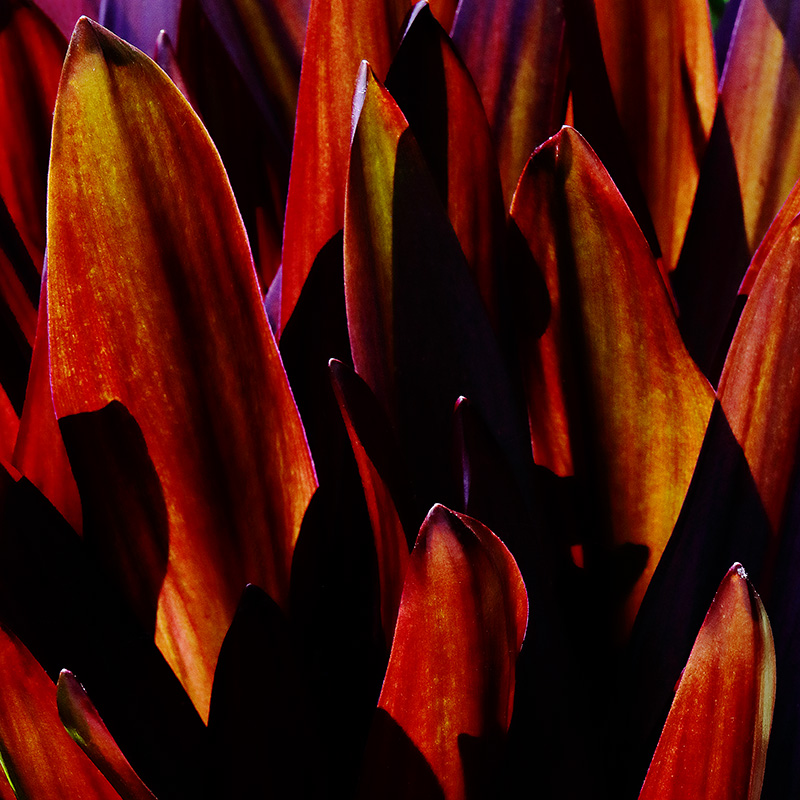
Gleaming Gems: Tulipa humulis ‘Little Beauty’

The red and purple flowers of Tulip 'Little Beauty'

NB: A note for WordPress Reader users – you need to click on the title of the post again to come out of the reader and go to the post itself. This allows you to see the whole of the top photograph. (Otherwise you may see just a tiny section!)

These bright little flowers are Tulipa humilis ‘Little Beauty’, a dwarf tulip that is creating a vibrant glow of colour here in my garden. They are very small tulips, growing only 4 to 6 inches high, with flowers around the size of a large crocus.

My reason for planting these, as opposed to the bigger tulip cultivars, is that they are a species tulip. That means that they are fully perennial and will probably multiply over the years. Most of my larger tulips have gradually died out and now there are just a few lonely leftovers scattered here and there in the borders. (The exception to this is a clump of viridiflora tulips which continue to flower well and slowly increase in numbers.)

I’m glad to say that these dwarf tulips have been a success since they were planted in 2002, having – so far – reliably reappeared each spring. Their resilience encourages me to try more species tulips in future. (I still like the bigger hybrid tulips, but to avoid the sad look of stray tulips left alone as they dwindle, I’d plant the hybrids in pots initially. After their first year I could move the bulbs to a mixed cut-flower area in our planned veggie garden to see if any survive and flower again.)

Tiny though they are, these tulips make plenty of impact when the sun shines. Then the petals open wide, allowing you to see their attractive markings. Inside the deep crimson flowers are centres of a rich purple-blue, edged by a border of pale pink. For me, ‘Little Beauty’ certainly lives up to its name, with its vivid colouration adding a lively gleam to the springtime garden.

Reddish-pink flowers of Tulipa humilis 'Little Beauty', which have a purple centre.
The crimson flowers of Tulipa humilis ‘Little Beauty’ have a purple-blue centre.

Small Changes

Frosted Miscanthus seed heads

NB: A note for WordPress Reader users – you need to click on the title of the post again to come out of the reader and go to the post itself. This allows you to see the whole of the top photograph. (Otherwise you may see just a tiny section!)

A lot of changes in the garden take place slowly, sometimes without being noticed until they’re complete. But frost, and the way it changes to semi-frozen beads before melting into glistening droplets has been a very visible feature here recently.

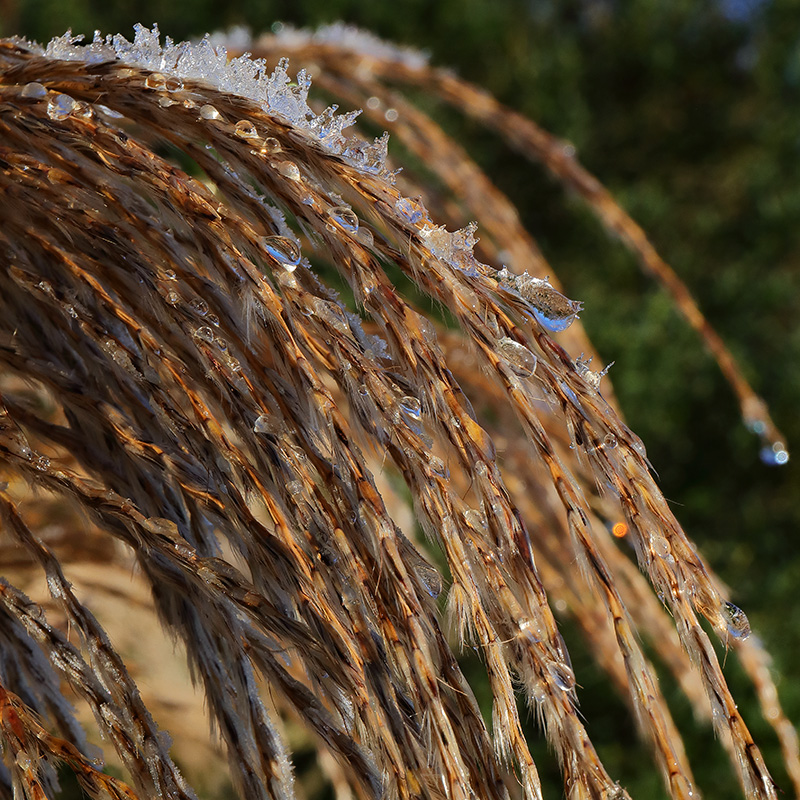
The top photograph shows the process of the thaw caught mid-way. There’s still an icy ridge of frost crystals running along the seed head, but below it the sun has melted the rest. It was the first time that I’ve photographed these Miscanthus seed heads – the frost added something extra to give interest to the image. (And they do tend to blow around in any breeze, so very still weather is needed for a decent photo.)

Frosted Miscanthus seed heads
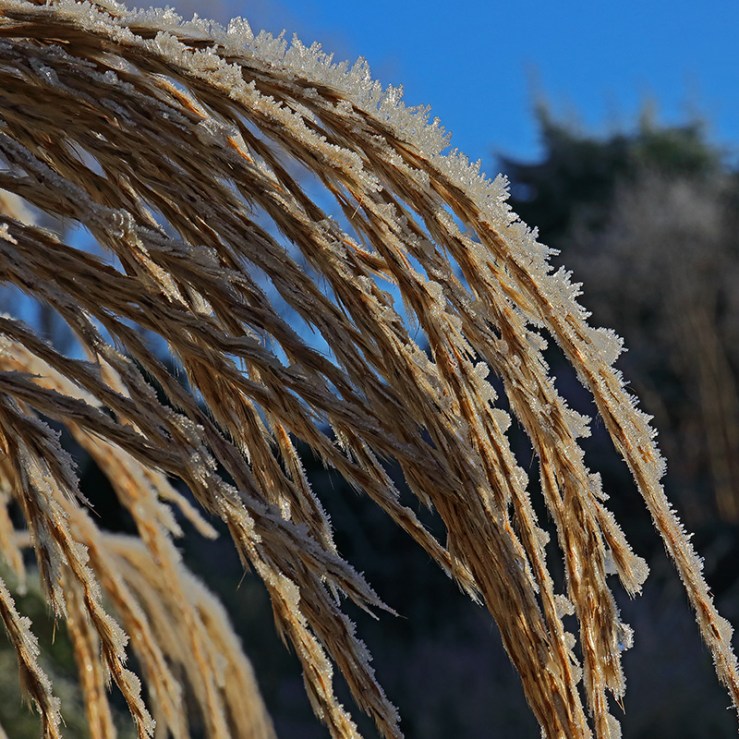
The Miscanthus seed heads were at their frostiest for this photograph.

You can see the seed head at its most frost-covered in the image above. It didn’t stay that way for long because the Miscanthus is growing in the area that gets the first sun of the morning. Any frost on this grass melts away very quickly. It’s only because we had several days of very low temperatures that there was this build-up of frost crystals.

Those frost crystals soon thawed in the sun and became the icy little drops that are seen in the photo below. But this wasn’t the only change taking place as I photographed the Miscanthus. I was surprised to see how quickly the hairs on the individual grass seeds fluffed out in the sun. (You can see how dry and airy-looking they’ve become in a very short space of time.)

I suppose the seeds must be programmed to wait until there’s some warmth before opening out their hairs and getting ready to fly away in the wind. Later on, when it was cooler, I noticed that they had closed up again. Since that morning, I’ve seen the fluffiness appear in the sunshine and disappear as the hairs close when it’s cold. Perhaps this is a way of protecting the seed-hairs in bad weather, so that they don’t get bedraggled, and allowing them to stay dry enough to let the seeds float away when the time is right. It’s an intriguing little change that had gone unnoticed here before.

Here the Miscanthus seed heads have suddenly opened up and become fluffy.

Hello Frost!

Frosted Rose 'Zepherine Drouhin'

NB: A note for WordPress Reader users – you need to click on the title of the post again to come out of the reader and go to the post itself. This allows you to see the whole of the top photograph. (Otherwise you may see just a tiny section!)

Last week I was hoping for the frost and sunshine that the forecast promised, but with no luck. Instead a frosty morning arrived unexpectedly a couple of days ago. There was even some sun…ideal for photography!

The rose you see here is Zepherine Drouhin, a fragrant climber that has no thorns. (A thornless rose is a delight – no getting scratched when you’re weeding beside it.) It often has a few flowers left late in the year, so is a frequent subject in my frost pictures. Luckily, it is even in a helpful position – just where it is protected from the earliest sun by nearby trees, but where the sun can make it sparkle by the time I’m likely to be outside with my camera.

The rose’s position with regard to the sun makes a huge difference. One side of my garden catches the earliest sun. That means any frost there is very quick to melt and it is often gone before I can photograph it.

In contrast, the other side of the garden remains in deep shade for a long time. This side is where the flowers that get deeply frozen usually are, but there is much less light to play with. It occurs to me now, that I should bring a big reflector outside to see if I can reflect some sun onto subjects there. Why hadn’t I thought of that before? Hmm, in too much of a rush to get outside while there was still frost, I guess…❄

Frosted rose petal
There’s not much left of this rose (‘Zepherine Drouhin’).

Gradually…

Purple verbascum flowers

NB: A note for WordPress Reader users – you need to click on the title of the post again to come out of the reader and go to the post itself. This allows you to see the whole of the top photograph. (Otherwise you may see just a tiny section!)

It has been quite a while since the flowers started to open on the purple mullein in my garden. (This variety is Verbascum phoeniceum ‘Violetta’.) The photographs here were taken before mid-May; now in June we’re still only about half-way up the flower spike. It will be some time before I can photograph open flowers at the top!

An advantage of the way the opening of the individual flowers slowly progresses upwards is that it makes the flower spike last longer. That’s good for the visiting bees and makes for a longer-lasting splash of purple. A win-win, as far as I’m concerned!

As well as lasting for a long time, the numbers of these flowers is gradually increasing over the years too. Each plant isn’t long-lived but they self-seed readily and have scattered seedlings around the parent plants. (I’ll give them a bit of help and sprinkle some seed around the rest of the garden.) Because I have no other verbascums, these have remained the same purple as the original plants and, with time, I’m hoping to have lots of them dotted through the borders. Meanwhile, I’m waiting to be able to photograph the top of the flower spike when it opens…

Purple verbascum flower

Waiting for the Light

Frosted Caryopteris clandonensis seed heads

NB: A note for WordPress Reader users – you need to click on the title of the post again to see the full photograph. (Otherwise you see just a tiny section!)

During winter direct sunlight doesn’t penetrate along much of one side of the garden. Photographing plants in this area can be frustrating. Even if they have a good coating of frost, they don’t catch the sun to make that frost sparkle.

Taller plants, like those here, do get some sun for a very short while, so there may be just enough light to make photographing them worthwhile. The light changes very quickly at this time of year, so the opportunity doesn’t last long.

Frosted climbing hydrangea
A climbing hydrangea is just tall enough to catch the light.

Happily, January brings a gradual increase in how far the sun reaches over the garden fences and tall shrubs, over time illuminating more of the smaller plants. By the time spring is here, the sun will be high enough to allow me to take photographs throughout the whole garden. That is a time I look forward to!

Meanwhile, it occurs to me that I should plan to place the plants that look good when frosted in places where they will catch a little sparkle of sun. (But not somewhere too sunny, otherwise the frost may melt before I get outside with my camera.) I may be developing my own style of garden planning – ‘hortus photographicus’, hehe!

Frosted Daucus (wild carrot) seed head
A frosted Daucus (wild carrot) seed head lurks on the dark side of the garden.

Happy Christmas to You!

frosted fennel

NB: A note for WordPress Reader users – you need to click on the title of the post again to come out of the reader and go to the post itself. This allows you to see the whole of the top photograph. (Otherwise you may see just a tiny section!)

I hope that this Christmas, whether you celebrate it or not, will bring you happiness and wellbeing. It has been a busy year for us, so a time of good cheer and a little bit of indulgence will be welcome. (We value quieter Christmases these days – they give a great feeling of peace and time to just relax.)

Despite my usual frosty photo for Christmas, it looks as if we’ll see no frost or snow over this year’s festive period. Christmas day is forecast to be sunny, so time outside in the garden is a possibility. But there will be no hoar-frost photos like this one taken last December…a rest for the camera maybe!

However you spend Christmas, I hope that it’s a good one. Merry Christmas! I wish you joy. 🎄

Frost and After

frosted gaura flower

NB: A note for WordPress Reader users – you need to click on the title of the post again to come out of the reader and go to the post itself. This allows you to see the whole of the top photograph. (Otherwise you may see just a tiny section!)

Last year’s hoar frost made icy little sculptures out of many of my garden plants. The one you see here is Gaura lindheimeri. (Now known as Oenothera lindheimeri, but I still call it by it’s old name. There are too many plant name-changes to keep up with these days!) This plant carries on flowering until late in the year, so frequently ends up covered in frost.

The area where the gaura is growing stays in the shade for much of the day in winter, so the frost lasts here for a long time. That gives me plenty of opportunities for taking photographs, but means that the sun doesn’t reach the frost to make it sparkle. So photography here is a bit of a compromise. Perhaps I should consider the effect of sun on frost when planting!

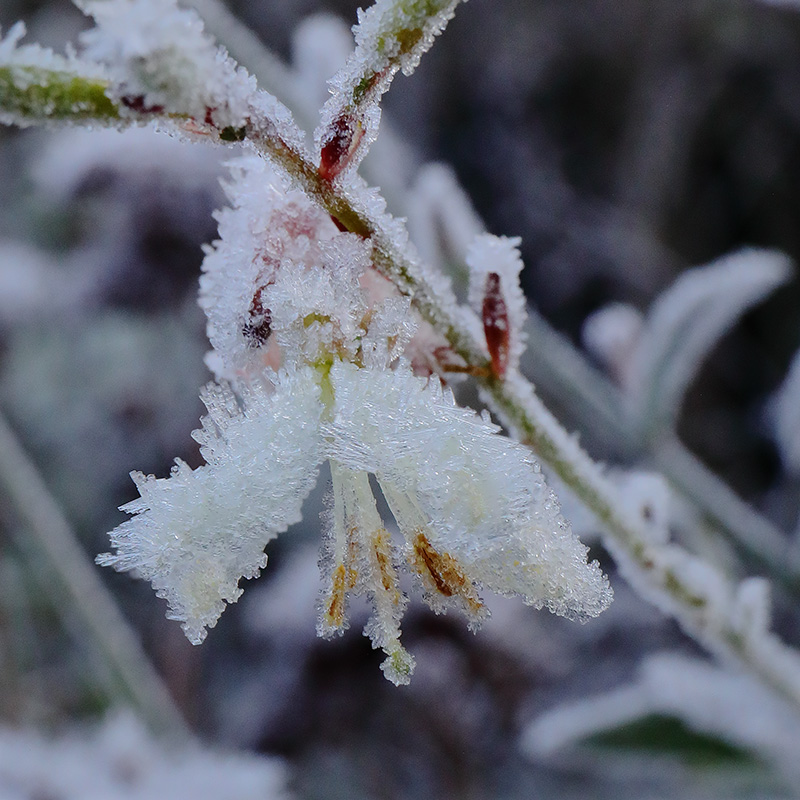
Eventually the frost will go, changing the look of the flower again. This time the petals are likely to be left translucent and looking very fragile indeed. (They usually wilt quickly after being frosted.) The drops of melted frost give an interesting texture to the flower – you can see right through the petals to the drops that are actually on the other side. ❄

Gaura with melted frost drops

Wet, Wet, Wet!

NB: A note for WordPress Reader users – you need to click on the title of the post again to come out of the reader and go to the post itself. This allows you to see the whole of the top photograph. (Otherwise you may see just a tiny section!)

It is raining, it has been raining, and there is more rain to come…

If you’ve been reading this blog for a while, you will probably have noticed that I frequently mention that we have a dry climate here in the east of England. Drought is something I worry about in the garden and I try not to have many plants that require moist ground.

Not raindrops but melted frost drops from last winter.

This week has felt quite strange because it has rained and rained. In fact, this summer was unusually rainy and our grass even stayed green. I’ve read that the heavier rainfall may be a part of global warming (because warm air can hold more moisture) but this does feel unexpected.

Because it has been so wet, I thought it appropriate to post some watery pictures. However, I have a confession to make…they aren’t raindrops, but drops of melted frost photographed last winter. (It has been much too wet and grey for me to want to take the camera outside.)

We have been lucky here. Storm Babet hasn’t caused much disruption. But elsewhere, especially in Scotland, people have been forced to leave flooded homes and much damage has been done. Sometimes the forces of Nature can be thoroughly alarming!

The golden oat (Stipa gigantea) looks at its best when covered in frost, even if that frost has melted.

Similar but Different: Orange and White Lilies

Orange and white lily flower

NB: A note for WordPress Reader users – you need to click on the title of the post again to see the full photograph. (Otherwise you see just a tiny section!)

It’s a fascination to me to see how diverse cultivars of the same flower species can be. If you think of something like dahlias, for instance, there’s a massive variation between their flower types. But even flowers that might sound the same when described can actually look quite different.

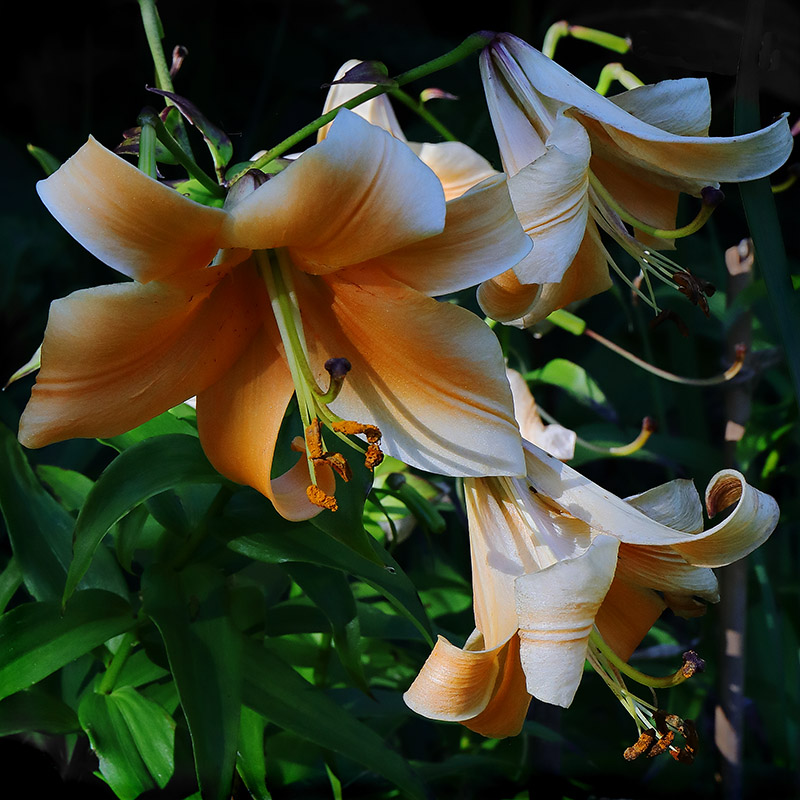
The lily flowers here are similar enough that when I reviewed my pictures after a garden-visit, I initially thought I had two sets of photos of the same plant. As soon as I paid them proper attention, I realised that they were in fact quite unalike. They have only superficial similarities of colour and flower shape.

At first glance, both lilies have swept-back (‘recurved’) petals and an orange and white colouration to their flowers. But a second look shows that the orange of the lily below is much softer and more muted than the one above. Additionally, the top lily has dark speckles on its petals and little bumps called ‘papillae’. (I’ve read that these papillae are important, because they secrete a substance that attracts insects. They are also exploited by lily breeders to produce a different look to flowers.)

I don’t grow lilies in my own garden (because I have cats and lilies would be a danger to them), so I don’t often get the chance to look at lily flowers very closely. Seeing and photographing them in other people’s gardens feels like a little voyage of exploration – one I enjoy tremendously! 🙂

Orange and white lilies

Into the Blue: Agapanthus

Agapanthus flower head (blue)

NB: A note for WordPress Reader users – you need to click on the title of the post again to see the full photograph. (Otherwise you see just a tiny section!)

I’ve been very busy in both house and garden recently and haven’t had so much time for photography here. (There has been a lot of change in the garden, which has created plenty of work to do. At the same time, work on the house has meant lots of rearrangement and change there too.)

But I have made time to visit a number of local gardens, so I’ve photographed flowers in them instead. That’s good, because it allows me to photograph plants I couldn’t otherwise. However, this is one that I should have been able to photograph at home. I left it a bit late, and my own agapanthus had too many flowers that were starting to go over. Happily, I’d already photographed these in someone else’s garden.

These flowers are actually a stronger colour than mine, which are a much paler blue. The individual flowers are a good size too. I find that my agapanthus can sometimes produce very small flowers and I wonder if it’s because they aren’t getting enough moisture. (I should probably water them more often!) If that’s the case, the extra rain this summer will have been a big help.

The blues of agapanthus are absolutely lovely, but they have other colours that are beautiful too. I’ve seen a fabulous deep purple that I like (‘Black Jack’), and I’m also tempted by some of the paler purples and a white tinged with blue…I would need a bigger garden to fit them all in! 🙂

Agapanthus flower head (blue)