Small Changes

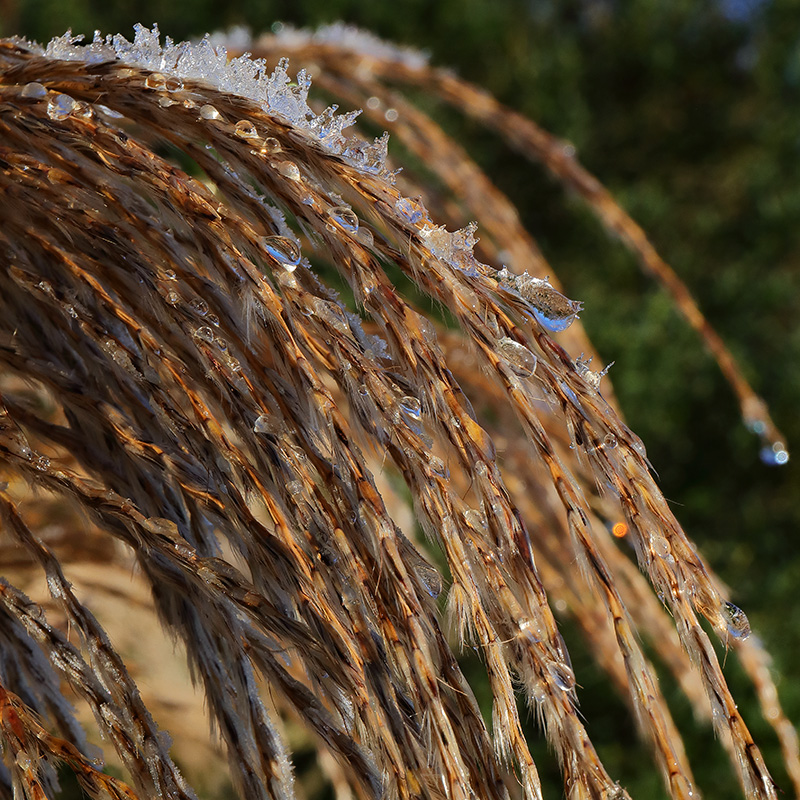
Frosted Miscanthus seed heads

NB: A note for WordPress Reader users – you need to click on the title of the post again to come out of the reader and go to the post itself. This allows you to see the whole of the top photograph. (Otherwise you may see just a tiny section!)

A lot of changes in the garden take place slowly, sometimes without being noticed until they’re complete. But frost, and the way it changes to semi-frozen beads before melting into glistening droplets has been a very visible feature here recently.

The top photograph shows the process of the thaw caught mid-way. There’s still an icy ridge of frost crystals running along the seed head, but below it the sun has melted the rest. It was the first time that I’ve photographed these Miscanthus seed heads – the frost added something extra to give interest to the image. (And they do tend to blow around in any breeze, so very still weather is needed for a decent photo.)

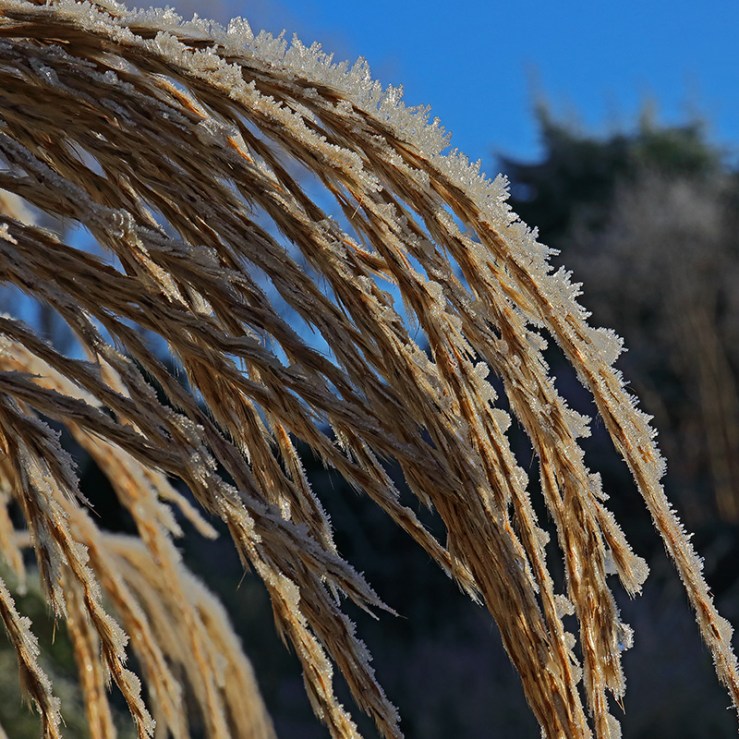
Frosted Miscanthus seed heads
The Miscanthus seed heads were at their frostiest for this photograph.

You can see the seed head at its most frost-covered in the image above. It didn’t stay that way for long because the Miscanthus is growing in the area that gets the first sun of the morning. Any frost on this grass melts away very quickly. It’s only because we had several days of very low temperatures that there was this build-up of frost crystals.

Those frost crystals soon thawed in the sun and became the icy little drops that are seen in the photo below. But this wasn’t the only change taking place as I photographed the Miscanthus. I was surprised to see how quickly the hairs on the individual grass seeds fluffed out in the sun. (You can see how dry and airy-looking they’ve become in a very short space of time.)

I suppose the seeds must be programmed to wait until there’s some warmth before opening out their hairs and getting ready to fly away in the wind. Later on, when it was cooler, I noticed that they had closed up again. Since that morning, I’ve seen the fluffiness appear in the sunshine and disappear as the hairs close when it’s cold. Perhaps this is a way of protecting the seed-hairs in bad weather, so that they don’t get bedraggled, and allowing them to stay dry enough to let the seeds float away when the time is right. It’s an intriguing little change that had gone unnoticed here before.

Here the Miscanthus seed heads have suddenly opened up and become fluffy.

When the Autumn Sun Shines…

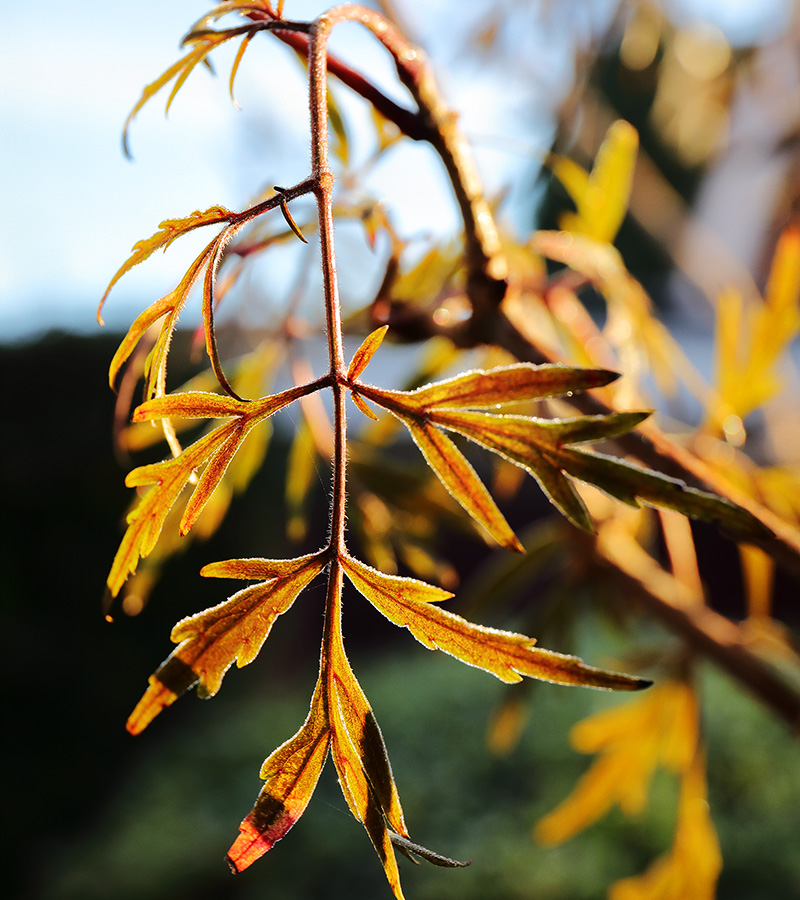
Wisteria leaves in autumn.

NB: A note for WordPress Reader users – you need to click on the title of the post again to come out of the reader and go to the post itself. This allows you to see the whole of the top photograph. (Otherwise you may see just a tiny section!)

It’s amazing to see how much difference some sunshine makes to the garden in autumn. After days of smothering grey, we suddenly have an airiness and brightness that brings out the best in the leaves that are turning yellow and gold. For a while, the outdoors feels welcoming again, and thoughts of the approach of winter can be set aside.

There is still some warmth in the sun, enough to entice me outside to work in the garden. This year I have been making lots of changes to the planting here. New plants have gone in and others moved to places where they will grow better or look more at home with their neighbours. (If only moving plants was as easy as moving furniture!)

As they become dormant for winter, plants can be moved to more suitable sites. Theoretically, I have plenty of time to get it all done before early spring, but it would be good to get it finished before the weather gets really cold or wet. So these sunny days have been ideal. At the same time, the low sunlight is reminding me to think about the effects of sunlight streaming through foliage and to look for ways to take advantage of it. It is, after all, primarily a photographer’s garden!

Images: top – Wisteria sinensis, below – Cotinus coggygria (smoke bush)

Cotinus (smoke bush) leaves in autumn

Waiting…

Autumn leaf of Elder (Sambucus 'Black Lace')

NB: A note for WordPress Reader users – you need to click on the title of the post again to come out of the reader and go to the post itself. This allows you to see the whole of the top photograph. (Otherwise you may see just a tiny section!)

In gardening, it often feels as if there is a pause while you wait for something to happen. Waiting for the right time to sow seeds, to see buds open, or to pick your harvest of fruit or vegetables. This week I’m waiting (and hoping) for the grey sky to clear and let a little sunlight through to the autumn leaves. They need that gleam of light to pick out their details and bring their images alive when I photograph them.

I’m waiting for the first frost of the year too… 🍂

Autumn leaf of Elder (Sambucus 'Black Lace')
Autumn leaf of Elder (Sambucus ‘Black Lace’), photographed on a frosty morning a couple of years ago.

A Plea for Butterflies

Small Tortoiseshell butterfly

NB: A note for WordPress Reader users – you need to click on the title of the post again to come out of the reader and go to the post itself. This allows you to see the whole of the top photograph. (Otherwise you may see just a tiny section!)

Back in August I posted about taking part in the annual ‘Big Butterfly Count’ which is held by UK charity Butterfly Conservation. The results of the nationwide count have now been published and they confirm that the UK has indeed had a very bad summer for butterflies. So much so, that the charity has labelled it a ‘butterfly emergency’.

This year’s count recorded the lowest number of butterflies in the 14-year history of its existence. A total of just over 935,000 butterflies and day-flying moths for 2024 was a drop of over a third in comparison to the figure of over 1.5 million for 2023. The average number of butterflies seen per count fell from last year’s 12 to seven for each count this year and there was also the highest ever number of counts where no butterflies were seen (9,000).

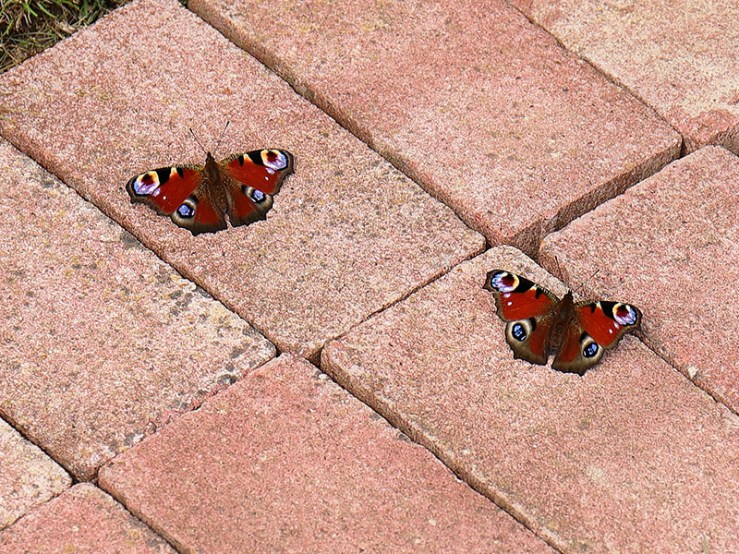
Peacock butterflies counted fell in numbers in England by 66%.

While habitat loss and this year’s wet and initially cool summer must both be at least partly to blame for the dramatic drop in butterfly numbers, Butterfly Conservation is seriously concerned about the effects of pesticides. Head of Science at Butterfly Conservation, Dr Richard Fox, said that neonicotinoid pesticides used on farmland can contaminate the wild plants growing around the edges of fields, killing the butterflies and moths and their caterpillars that feed on them.

In an effort to protect future generations of butterflies (and of course, other insects), Butterfly Conservation is calling for a complete ban on neonicotinoid pesticides in the UK. (They were banned in 2018, but an exception was made for their use on sugar beet.) The request for the ban is being made in an open letter to the Secretary of State and they are asking UK residents to support that request by signing their letter. You can find the letter here. (And you can see the full report on butterfly numbers here.)

The photographs in this post weren’t taken this year, but in 2020 and 2021. This year there were very few butterflies in my garden, so I had very little chance to photograph any. Like many people this year, I noticed that my garden was unusually empty of butterflies, bees, and the other insects that I normally expect to see here. (The small tortoiseshell in my top photo was one of England’s worst-affected species with a drop of 72% from the numbers in last year’s count. Holly blue numbers fell in England by 80% and red admirals by 82%.)

I hope that those who can sign this letter will do so – it’s a small chance to do something that may help preserve all of our insects, not only the beautiful butterflies.

Comma butterfly
A comma butterfly looking a bit the worse for wear – their count fell by 51% in England this year.

Small Signs of Hope

Red admiral butterfly on buddleia

NB: A note for WordPress Reader users – you need to click on the title of the post again to come out of the reader and go to the post itself. This allows you to see the whole of the top photograph. (Otherwise you may see just a tiny section!)

This summer butterflies have been pretty much absent. However, this week there have been several flitting around the garden and feasting on the last of the buddleia flowers. There weren’t many, but they were very welcome and they brought with them the hope that there may be more butterflies next year.

The red admiral shown here was one of a group of five that found the only buddleia that was still flowering well. This particular plant is one that I had intended to remove, but had found it impossible to dig out. (I have a number of more attractively-coloured named varieties in the garden, so I had decided to remove some of the more ‘ordinary’ buddleias. This one is one of the progeny of a massive shrub that was in the garden when we arrived. It seems that its family line is destined to continue!)

The severe and later than usual cutting-back prevented this buddleia from flowering at the same time as the others. That turned out to be an advantage for this group of late butterfly visitors. Next year I’ll cut the buddleias back at slightly different times so that the flowers will be spread over a longer period. Then there should still be something to feed butterflies that arrive later on, rather than all the flowers being over by this time.

The red admirals briefly had a small tortoiseshell butterfly as a companion, but I suspect they chased it away. I spotted it feeding much higher up and too far away for me to be able to photograph it. (But you can see a photo from a previous year in this post.) This was the only small tortoiseshell I’ve seen this year.

Other interesting visitors to the garden this week were a couple of elephant hawk-moths and one of their caterpillars. (Found on a very small potted fuchsia. I brought the pot up to a much larger fuchsia and later noticed that the caterpillar had very obligingly transferred itself to the less vulnerable plant.) This is only the second time that I’ve seen elephant hawk-moths here, so I’m hoping that there will be more in the garden next year. 🦋

Red Admiral butterfly on buddleia
Red admiral butterfly on buddleia

Missing: Butterflies…

Comma butterfly

NB: A note for WordPress Reader users – you need to click on the title of the post again to come out of the reader and go to the post itself. This allows you to see the whole of the top photograph. (Otherwise you may see just a tiny section!)

‘Where are the butterflies this year?’ I’ve heard that question from many folk here in the UK this year. The rain and lack of warmth earlier in the summer have been blamed, especially after the previous very wet and windy weather in the spring.

It has become warmer and more summery recently but there still aren’t many butterflies around. At this time of year I take part in the ‘Big Butterfly Count’, run by the UK charity, Butterfly Conservation. Butterfly Conservation has reported that the numbers of butterflies recorded this year are the lowest ever in the 14 years of holding it. Although the poor weather has made it hard for butterflies to fly and to mate this year, their numbers have already been in decline in recent decades. Much of this is attributed to the loss of habitats, pesticides, and now a changing climate.

My photographs here were not taken this summer, but in previous years. There simply haven’t been enough times when I’ve seen butterflies in the garden to be able to photograph them. For my count here, it was noticeable that there was a huge drop in the numbers of those that are usually the commonest. There was only one peacock butterfly and no red admirals at all. (I have in the past seen a dozen peacock butterflies sunning themselves on our brick path and around the same number of red admirals feasting on a buddleia.)

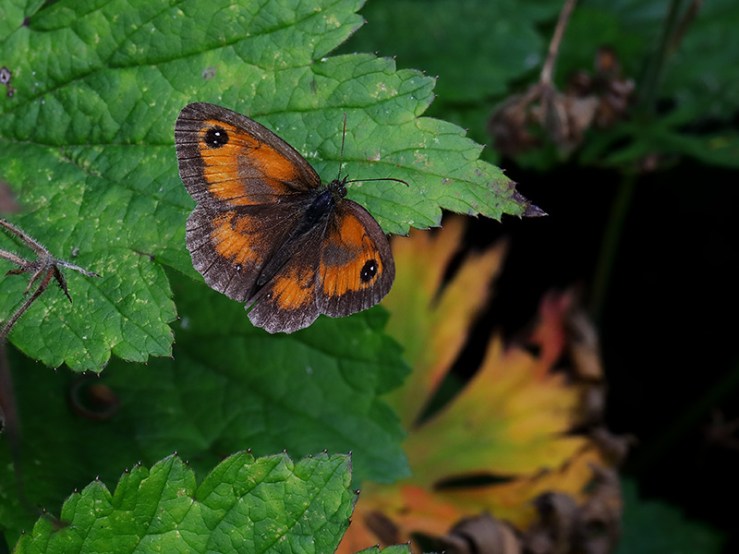
For one particular butterfly – the gatekeeper (below) – there was actually a slight rise in numbers. This year I saw five of them during the 15-minute count. Last year I think it was three. (We are probably seeing more of these because we now have both blackberries and thyme in the garden for the adults to feed on.) Other butterflies – large white, small white, and comma (top photo) were sighted but, again, in fewer numbers. There was a single brimstone, which I’ve only seen once during a count, but no small tortoiseshell this year.

It’s not just a poor year for butterflies here, but for bees too. Normally there would be lots in the garden, but now there are very few. (Spring was good at one point, and I noticed that the ajuga was absolutely buzzing while it was in flower.) I hope that the insect numbers will be able to recover in warmer years, but I feel that I may need to do more to provide both habitat and food to encourage these visitors. In particular, I’d like to grow food plants that will be available over a longer period, especially for any late-arriving butterflies and bees. 🦋

Gatekeeper butterfly
Gatekeeper butterfly on an anemone leaf

Happy Christmas to You!

frosted fennel

NB: A note for WordPress Reader users – you need to click on the title of the post again to come out of the reader and go to the post itself. This allows you to see the whole of the top photograph. (Otherwise you may see just a tiny section!)

I hope that this Christmas, whether you celebrate it or not, will bring you happiness and wellbeing. It has been a busy year for us, so a time of good cheer and a little bit of indulgence will be welcome. (We value quieter Christmases these days – they give a great feeling of peace and time to just relax.)

Despite my usual frosty photo for Christmas, it looks as if we’ll see no frost or snow over this year’s festive period. Christmas day is forecast to be sunny, so time outside in the garden is a possibility. But there will be no hoar-frost photos like this one taken last December…a rest for the camera maybe!

However you spend Christmas, I hope that it’s a good one. Merry Christmas! I wish you joy. 🎄

From Very Little…

Frosted Pulsatilla Leaves

NB: A note for WordPress Reader users – you need to click on the title of the post again to come out of the reader and go to the post itself. This allows you to see the whole of the top photograph. (Otherwise you may see just a tiny section!)

Frost has an amazing ability to enhance the smallest of garden details. It takes very little to allow it to create a fleeting beauty. Anything can suddenly become attractive when encrusted by these tiny, white crystals of ice.

The last of the year’s flowers, dried-out seed heads, leaves, or slender grasses stilled by the cold air – all are made much more interesting to look at by a touch of frost. These are the leaves of Pulsatilla vulgaris (pasqueflower). In spring they are soft and hairy and a delight to stroke. By winter those hairs have disappeared, giving the curving shapes of the deeply-cut leaves more prominence. To my mind, the dead and frosted leaves suggest the look of a woodcut image or engraved stone.

As I’m writing this, the ground is still frozen. Tomorrow, though, is forecast to be milder and rainy, so the magic of the frost will be gone from the garden. These leaves won’t last long once the frost has finished with them, but will be left limp and probably rather translucent. The frost will have helped them along their path of decomposition and their eventual contribution to the richness of the garden soil. 🍂

Frosted Pulsatilla Leaves

Fruitful Times

Braeburn apples on the tree

NB: A note for WordPress Reader users – you need to click on the title of the post again to come out of the reader and go to the post itself. This allows you to see the whole of the top photograph. (Otherwise you may see just a tiny section!)

There are hardly any flowers left in the garden now, so almost everything is in shades of green, with a few leaves turning yellow here and there. (There are still the purple leaves of the smoke bush in the front garden. With a bit of luck, these will turn some interesting shades of yellow and orange – if they don’t get blown off first!)

During the last week, I’ve seen a bit of colour from fruits and berries in the garden. We finished picking the fruit from our apple trees a couple of days ago…you can see the last of the fruit on our Braeburn tree above. Our other apple tree is a Cox’s Orange Pippin which had already had its fruit picked a little while ago, so the Braeburn’s apples give later colour.

Near the apples we have a holly bush. I was considering cutting it back a lot this year because it has grown somewhat tall and spindly. I’m glad I didn’t do it, because this year there are more berries on it than I’ve seen before. This means a feast for the blackbirds!

The blackbirds (which are my favourite garden bird – alongside the robin) must do quite well here. We have two grapevines, one of which is huge and shades an arbour. The blackbirds seem to be constantly in and out of this when there are ripening grapes. We only eat a few of the grapes ourselves (they don’t get very sweet), so we don’t begrudge them to the birds. There are plenty of other berries, including the orange-red berries of our rowan tree and, later on, the ivy berries. It’s just as well that we have these to distract the birds, because blackbirds are partial to apples too… 🙂

Holly berries
The holly has more berries than usual this year.

Wet, Wet, Wet!

NB: A note for WordPress Reader users – you need to click on the title of the post again to come out of the reader and go to the post itself. This allows you to see the whole of the top photograph. (Otherwise you may see just a tiny section!)

It is raining, it has been raining, and there is more rain to come…

If you’ve been reading this blog for a while, you will probably have noticed that I frequently mention that we have a dry climate here in the east of England. Drought is something I worry about in the garden and I try not to have many plants that require moist ground.

Not raindrops but melted frost drops from last winter.

This week has felt quite strange because it has rained and rained. In fact, this summer was unusually rainy and our grass even stayed green. I’ve read that the heavier rainfall may be a part of global warming (because warm air can hold more moisture) but this does feel unexpected.

Because it has been so wet, I thought it appropriate to post some watery pictures. However, I have a confession to make…they aren’t raindrops, but drops of melted frost photographed last winter. (It has been much too wet and grey for me to want to take the camera outside.)

We have been lucky here. Storm Babet hasn’t caused much disruption. But elsewhere, especially in Scotland, people have been forced to leave flooded homes and much damage has been done. Sometimes the forces of Nature can be thoroughly alarming!

The golden oat (Stipa gigantea) looks at its best when covered in frost, even if that frost has melted.