Lurking in the Shadows: Arisaema

Flowers of Arisaema candidissimum

NB: A note for WordPress Reader users – you need to click on the title of the post again to come out of the reader and go to the post itself. This allows you to see the whole of the top photograph. (Otherwise you may see just a tiny section!)

Visitors to Fullers Mill can rely on it as a place to see unusual plants. Recently I saw these flowers of Arisaema candidissimum (AKA ‘Jack in the pulpit’ or cobra lily) there, growing in a shady space under some trees. This is the first time I’ve seen this particular plant, although I’ve previously seen a darker arisaema in this garden.

It’s an odd-looking flower, with a tubular, curved spathe that is striped with pink inside. (Sometimes they can be plain white inside.) The outside of the spathe has a subtle green stripe and the leaves are large, strongly veined, and a lush green, which gives the plant a very exotic, tropical look. I’ve read that the flowers have a sweet scent, but couldn’t get close enough to them to experience it for myself. (These photographs have had quite a bit of cropping.)

Arisaema is not a plant that I’m likely to try in my own garden, given that it prefers a rich soil with plenty of humus (although I am working on that one). It also needs reliable moisture and dappled shade (not much of either of those here). I could try to grow arisaema in pots, but I’d prefer not to have something that would resent drying out – it’s too hot here these days!

It’s good to be able to enjoy the sight of an unfamiliar plant when I’m out on a garden visit. Fuller’s Mill is a garden that has rather different conditions to mine, even though it’s not far away from us, so there’s always something that we can’t grow here.

(You can see the darker Arisaema in this post.)

Flowers of Arisaema candidissimum
The pink-striped tubular spathes and large green leaves of Arisaema candidissimum give it a tropical look.

A Prickly Presence

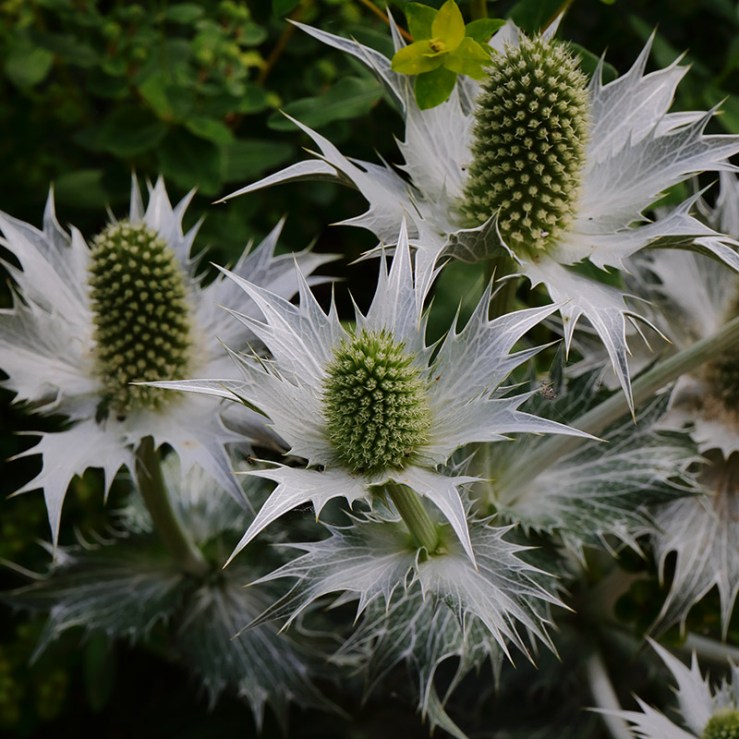
Eryngium giganteum (eryngo, giant sea holly) in flower, showing the silvery bracts and tiny greenish flowers.

NB: A note for WordPress Reader users – you need to click on the title of the post again to come out of the reader and go to the post itself. This allows you to see the whole of the top photograph. (Otherwise you may see just a tiny section!)

Amongst all the frill and froth of a summer garden, it’s interesting to see the more sculptural presence of a plant like eryngium. Its spiky leaves contrast with the delicate petals around it, while their silvery sheen is an attractive compliment to any flower colour.

I have the much smaller Eryngium planum (blue eryngo) in my own garden, but it doesn’t have the same impact as this Eryngium giganteum. It’s a plant that I would like to make room for here, and I’m having fun imagining what I might pair it with. Small flowers held on long, airy stems could look interesting. I’d like to see what it would look like with the ‘butterflies’ of gaura floating around it and with another, dark-coloured plant to contrast with both. Or perhaps with the small spires of a blue-flowered veronica for a variation in both shape and colour…the possibilities are many.

This particular plant looks like it may be either ‘Miss Wilmott’s Ghost’ or its improved version, ‘Silver Ghost’. For those who haven’t heard the story, Ellen Wilmott loved this eryngium so much that she used to sprinkle the seeds secretly in the gardens she visited – resulting in silvery surprise plants later on. Whether the story is true or not, it remains a popular myth (and possibly the earliest version of ‘guerrilla gardening’).

This handsome plant would be a very welcome surprise in my own garden, but, in the absence of ghostly seed-sprinklers, I think I’ll need to go and buy my own. It’s a short-lived perennial or biennial which self-seeds in areas that suit it, so if I do plant it, I will probably find plenty of seedlings to keep it going. Perhaps Miss Wilmott would have approved.

Eryngium giganteum (eryngo, giant sea holly) in flower, showing the silvery bracts and tiny greenish flowers.
Eryngium giganteum, showing the silvery bracts and the still-green flowers, which will turn blue as they mature.

Pick of the Purples

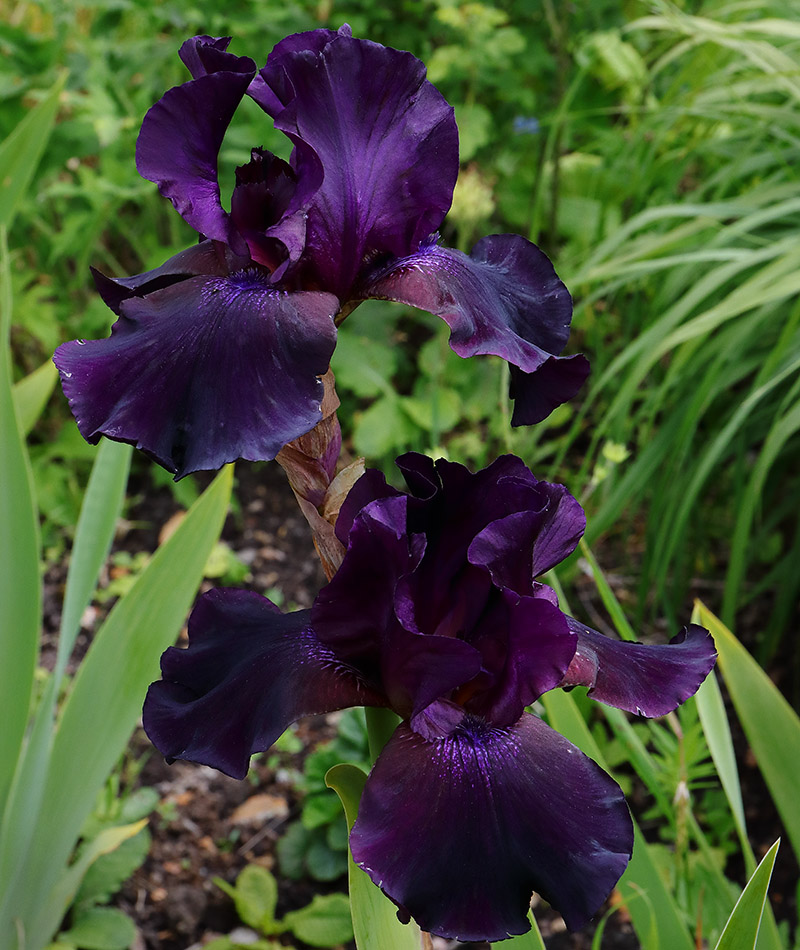
Dark purple bearded iris flowers

NB: A note for WordPress Reader users – you need to click on the title of the post again to come out of the reader and go to the post itself. This allows you to see the whole of the top photograph. (Otherwise you may see just a tiny section!)

Purple flowers always get my attention. They may be dark and dramatic, like the irises above, or as delicate and pretty as the iris below. I saw (and admired) these on recent garden visits…and, of course, I wondered if there was any chance of finding space for them in my own garden.

I believe the bearded iris in the top photo may be ‘Superstition’. (An internet image search gives a variety of colourings for that cultivar, but most resemble this plant closely.) The darkest of flowers are borne on stems around 3ft high, making a great contrast with pale-coloured flowers. For even more contrast, neighbouring planting could be something light and delicate, with a haze of small flowers to counteract the visual weight of the larger iris flowers.

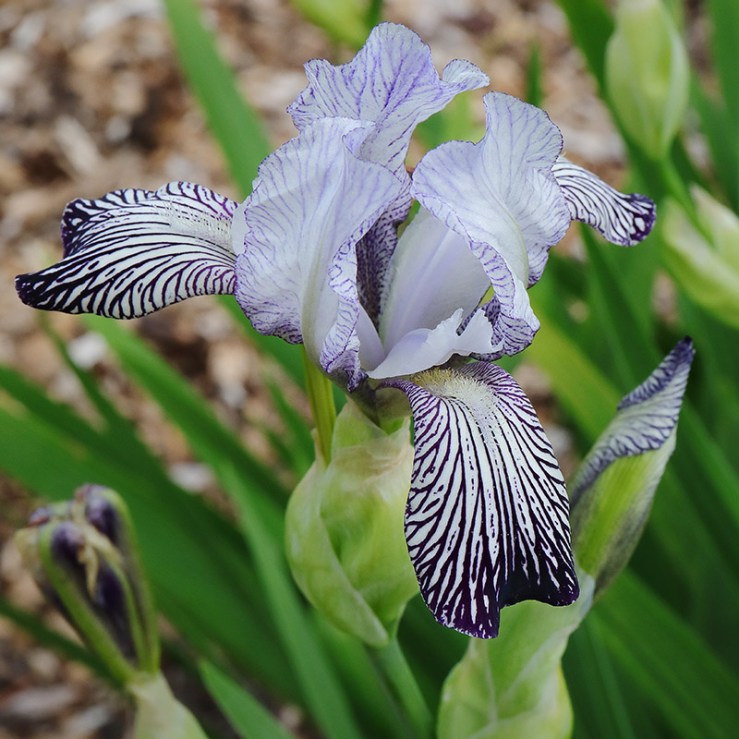
The second iris is the one I’d most like to grow here. Veining on flower petals is something I love to photograph and this is a beautiful example. The dark – almost black – purple against the white makes me think of ink on paper and the effect of the lines feels almost calligraphic. Such elegance! I like the way the veining is much softer on the standards, with just the palest lilac-purple tracery on the white ruffles. This plant appears to be Iris variegata var. reginae (AKA Iris germanica ‘Variegata Reginae’). I’ve never seen this iris before, so I haven’t seen it for sale around here, but if I do, I’ll be very tempted. (Or I could just buy it online…)

Iris variegata var. reginae

The petals of Iris variegata var. reginae have dark, calligraphic lines of inky purple on a white base.

Floral Favourites

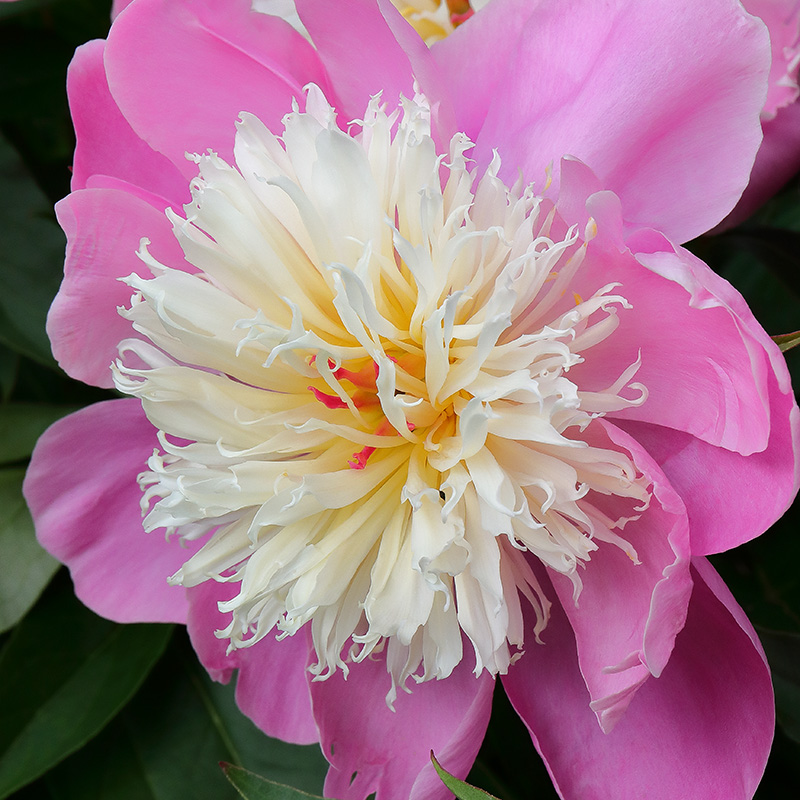
A pink and cream flower of peony 'Bowl of Beauty'

NB: A note for WordPress Reader users – you need to click on the title of the post again to come out of the reader and go to the post itself. This allows you to see the whole of the top photograph. (Otherwise you may see just a tiny section!)

Around here, villages and towns have ‘open gardens’ in the summer. That’s a day when they will have a number of gardens that are open to visitors in aid of local charities. It sometimes means a lot of walking and (even with the maps we’re given) there can be a bit of detective work to find the gardens. Despite that, it’s a fascinating exploration of other people’s gardens and a fun way to get to know the local area better.

You soon see what the favoured plants for the season are too. At this point in the year there were no surprises. Our latest garden walkabout demonstrated the unmatched popularity of roses, the most-loved flower in UK gardens. Other must-haves were irises, alliums and lavender – all expected garden staples for June. (And all plants that I grow too.)

Some of the most frequently-grown of the plants were ones that we don’t have in our own garden. We saw beautiful peonies in a number of the gardens we visited, all at their frilly best. It seems that the two familiar lovelies here (‘Bowl of Beauty’ above, and ‘Sarah Bernhardt’ below) are very much cherished by our local gardeners. It’s easy to see why, and it’s a great pleasure to be able to enjoy the sight of flowers that we would otherwise miss out on. (It may even push me to create a space for a peony or two here…)

A pink flower of Paeonia lactiflora 'Sarah Bernhardt'
A pink flower of Paeonia lactiflora ‘Sarah Bernhardt’ is not yet fully opened.

Still Going Strong

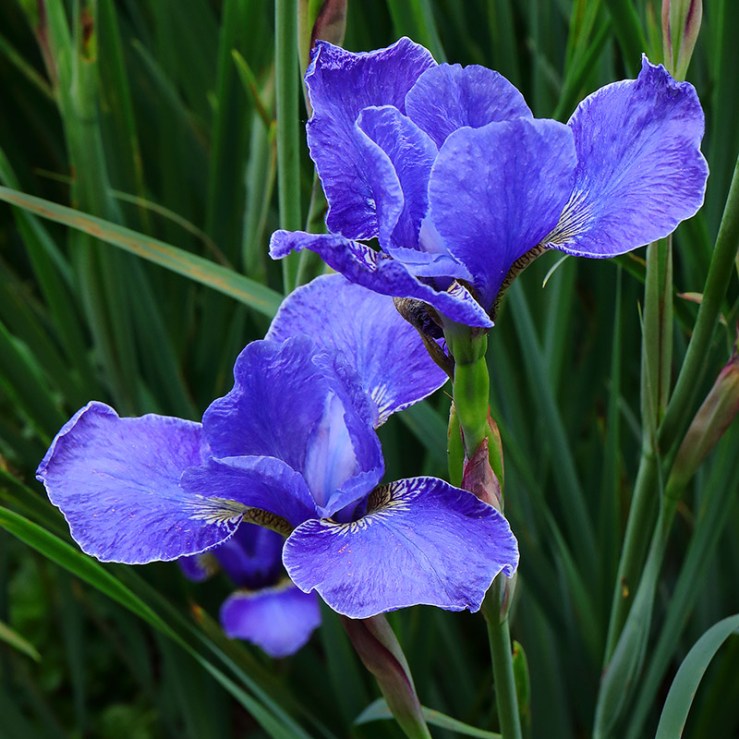
A dark purple-blue Siberian iris flower (Iris sibirica)

NB: A note for WordPress Reader users – you need to click on the title of the post again to come out of the reader and go to the post itself. This allows you to see the whole of the top photograph. (Otherwise you may see just a tiny section!)

On my visit to Fullers Mill earlier this week, I was surprised to see that their Siberian irises were still flowering. Not only that, but they had plenty of buds still too. Those in my own garden finished flowering a little while ago. (I’ve even had enough time to deadhead them all.)

Blue flowers of Iris sibirica 'Silver Edge'
Iris sibirica ‘Silver Edge’

Perhaps the reason for the variation in flowering time is that my garden has been hotter and the soil more dried out. At Fullers Mill there are a lot of trees, which must help to give some shelter from the heat of the sun. There seems to be more moisture in the soil there too. Whatever the reason, it was a pleasure to be able to see these lovely plants still in flower.

The deep purple-blue tones of the iris in the top photo captivated me. The petals have a velvety look, enhancing the opulent effect of the flower. (I’d love to have enough space to grow this one – probably ‘Shirley Pope’ if anyone else has the same thought.) I recognise the second iris (photo above) because I have it in my own garden. It’s ‘Silver Edge’. Unfortunately, my plant is sulking a bit after having been moved, but hopefully it will recover and flower more prolifically in future.

A white Siberian iris
This white Siberian iris may be ‘White Swirl’.

Another guess, aided by a Google photo search, makes me think that the white and yellow iris above may be ‘White Swirl’. Although it’s the blue irises that capture my affections, the calm and elegance of white is often exactly what’s needed to create a quiet space away from the hurly-burly of bright colours.

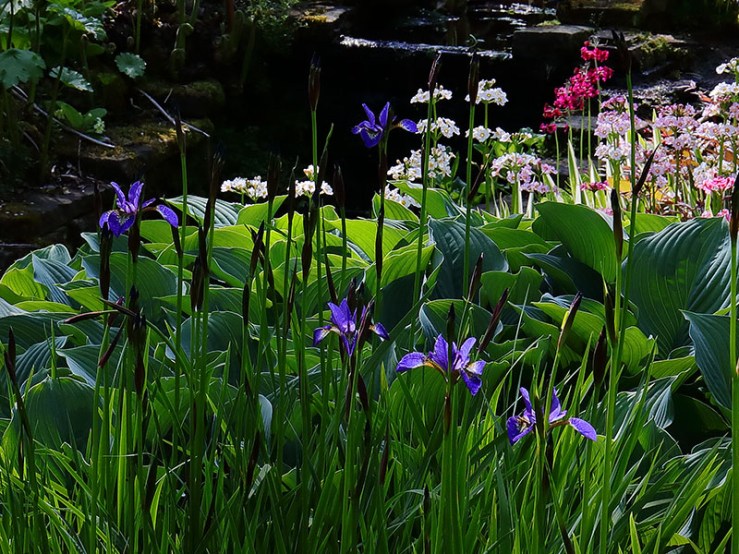
The photo below (from a different garden) shows a planting of blue Siberian irises, with perfect (unchewed by slugs and snails) hostas and pretty candelabra primulas. Oh, how I would love to be able to re-create this in my own garden! (Especially if I could have the stream that’s hiding behind it too) I can always dream!

Siberian irises in a waterside planting with hostas and primulas
Siberian irises look perfect in a waterside planting with hostas and primulas.

Other People’s Flowers

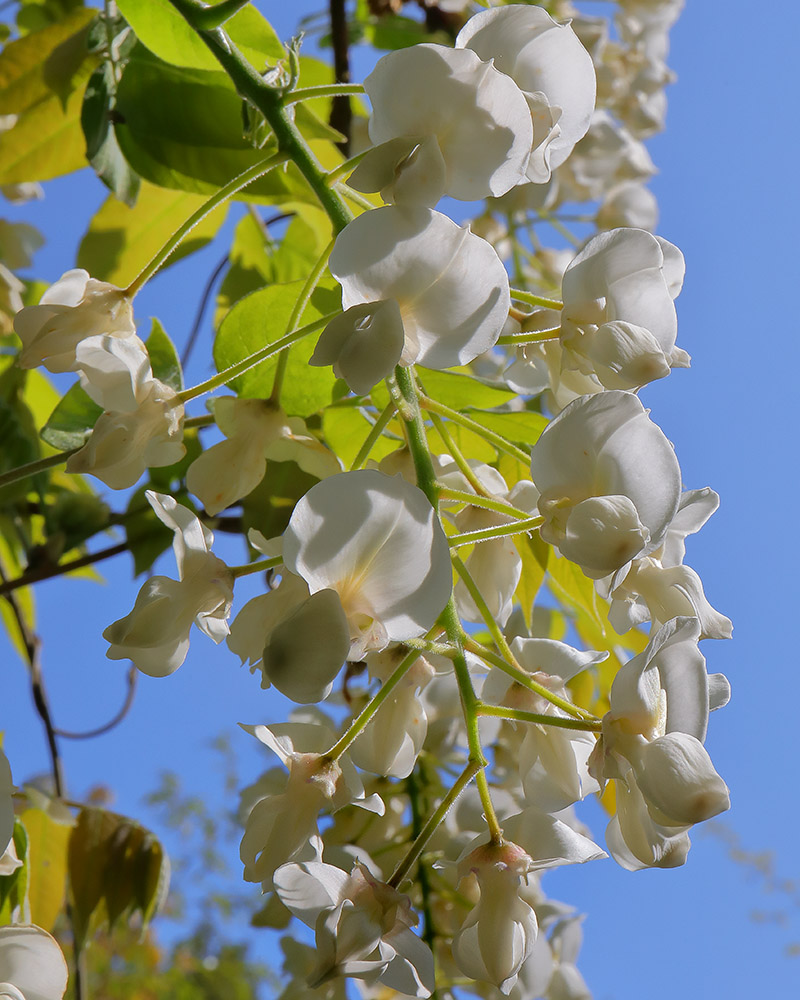
White wisteria flowers against a blue sky.

NB: A note for WordPress Reader users – you need to click on the title of the post again to come out of the reader and go to the post itself. This allows you to see the whole of the top photograph. (Otherwise you may see just a tiny section!)

With spring comes the urge to start visiting gardens again. It’s fascinating to see what other people grow and how they put their gardens together. Naturally, I take my camera too, though perhaps not to the smaller gardens if it seems intrusive. (It would be all too easy to forget that a garden is part of someone’s home.)

Being able to photograph other people’s plants helps me to sustain this blog – something that would soon become impossible if I had to rely on the limited number of plants in my own garden. I do photograph my plants from year to year, but I try to wait a couple of years or more before posting the same plants here. So getting out on a garden visit is essential to bring some variety to this blog.

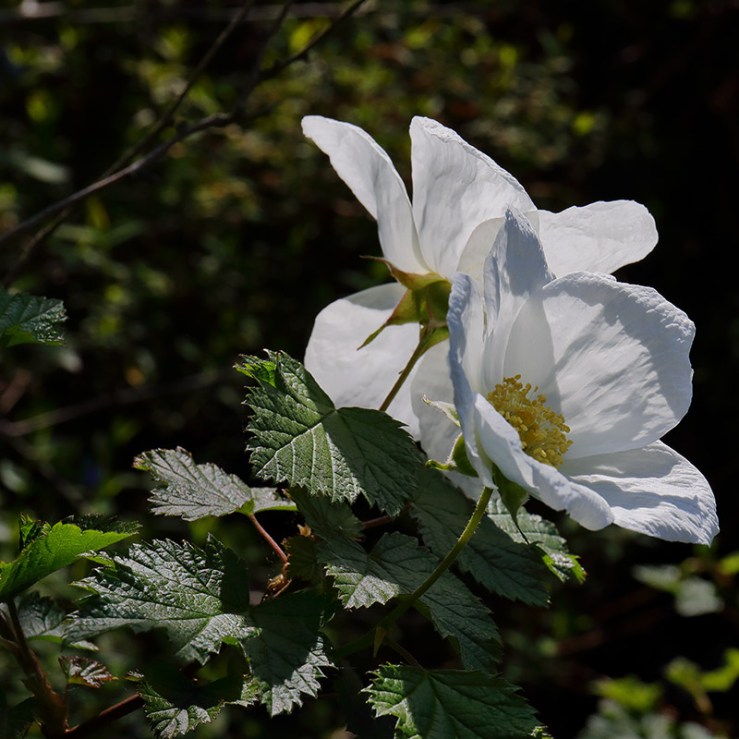
White flowers of Rubus 'Benenden' (Tridel berry, ornamental bramble).
Rubus ‘Benenden’ shows that it’s related to roses.

I sometimes find plants that surprise me, as in the sheer size of the white wisteria in the top photo. It was growing up a huge conifer and pretty much covering the whole tree. Whether, or how, it was ever pruned I don’t know, but it looked most impressive. The same garden provided a little mystery for me too, in the shrub shown in the photo above. Something I’d never seen before. I could see that the flowers looked like they could be related to the rose family, but that the leaves were a different shape. A little bit of Googling suggested to me that it is Rubus ‘Benenden’, an ornamental bramble and a member of the Rosaceae.

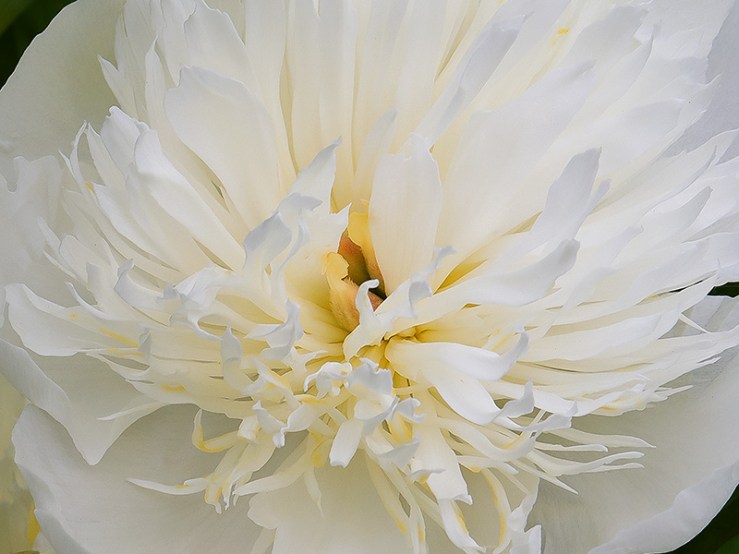
Centre of a white peony flower
The centre of a white peony in all its frilly glory.

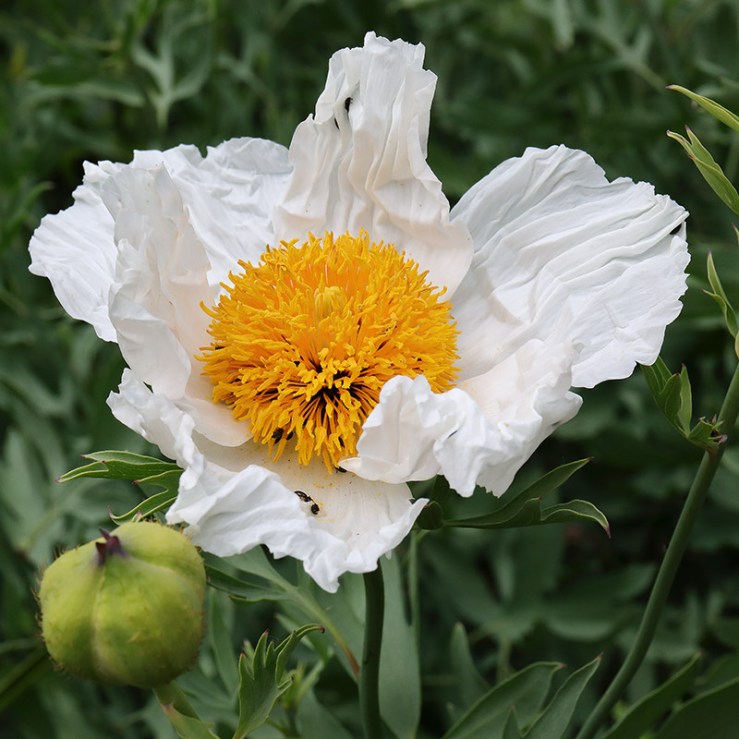
My next two plants are more familiar to me…above is a white peony and below is Romneya coulteri, the Californian tree poppy. Both of these are fairly frequent sights in the gardens we visit, but plants we’re unlikely to grow in our own garden. That’s partly through lack of space, and partly through not having quite the right growing conditions. (The Romneya can spread and would take more room than we have to spare, while peonies prefer a richer and heavier soil than we could give them.)

Visiting gardens lets me experience the beautiful plants that other people grow and often gives me the opportunity to to photograph something different to help fill this blog. (As all my fellow bloggers will know, blogs are always hungry for more material, especially photos.) On the day that this is posted, I’m planning to visit one of my favourite gardens in our area (Fullers Mill). If all goes well, the resulting photographs should keep this blog fed for a little while! 🌼

A white flower of Romneya coulteri (Californian tree poppy).
Romneya coulteri (Californian tree poppy), displaying the large central boss of yellow stamens.

(Almost) Silent Sunday: Allium siculum

Flower head of Nectaroscordum siculum.

NB: A note for WordPress Reader users – you need to click on the title of the post again to come out of the reader and go to the post itself. This allows you to see the whole of the top photograph. (Otherwise you may see just a tiny section!)

I’m a bit under the weather this week, due to a nasty cough and cold, so haven’t felt like doing any photography. Instead, here is one from the archives – Allium siculum (AKA Nectaroscordum siculum), or Sicilian honey garlic, much-loved by bees. 🐝

Not Blue: Iris sibirica ‘Currier’

Iris sibirica 'Currier'

NB: A note for WordPress Reader users – you need to click on the title of the post again to come out of the reader and go to the post itself. This allows you to see the whole of the top photograph. (Otherwise you may see just a tiny section!)

When I began to get interested in plants, I thought that Siberian irises were always a shade of blue or perhaps a purple-blue. In my previous garden, I grew blue Iris sibirica and Iris sibirica ‘Golden Edge’ (which is a gorgeous deep violet-blue with a golden edge to the falls). So, years later, when I saw the magenta-purple flowers of Iris sibirica ‘Currier’ I was surprised.

I shouldn’t have been surprised at all. Plant breeders have been busily creating cultivars which come in an impressive variety of colours. Now you can find Siberian irises in a wide range of reds, pinks, and yellows, as well as blues purples and white. (And I wish I had more space to grow them!)

However, pretty as many of the newer cultivars may be, I feel that some of the fancier-looking ones, especially the bi-colours, would not fit into the more naturalistic look of much of my garden. (Some of these more recently-bred Siberian irises can vie with the bearded irises for frilliness and flamboyance.) I prefer the slim elegance and more delicate look of the flowers of the plants that are closer to the original species.

The flower shape of ‘Currier’ is very similar to the blue Siberian irises that grow alongside it. The variation of the colour adds some interest to the plant grouping. That pinkish-purple colouration is picked up by the nearby magenta-pink flowers of ragged robin (Silene flos-cuculi, seen in this post). I still have a long way to go to create the look of the garden that I hope for; plants like this iris are a big help with that. (Having said that, I might still want to find a little space somewhere for one or two of the frillier Siberian irises – I can always be tempted by a plant that would make a good photograph!)

Iris sibirica 'Currier'

Small Wonders

Yellow-centred pink flower of tulip 'Lilac Wonder'

NB: A note for WordPress Reader users – you need to click on the title of the post again to come out of the reader and go to the post itself. This allows you to see the whole of the top photograph. (Otherwise you may see just a tiny section!)

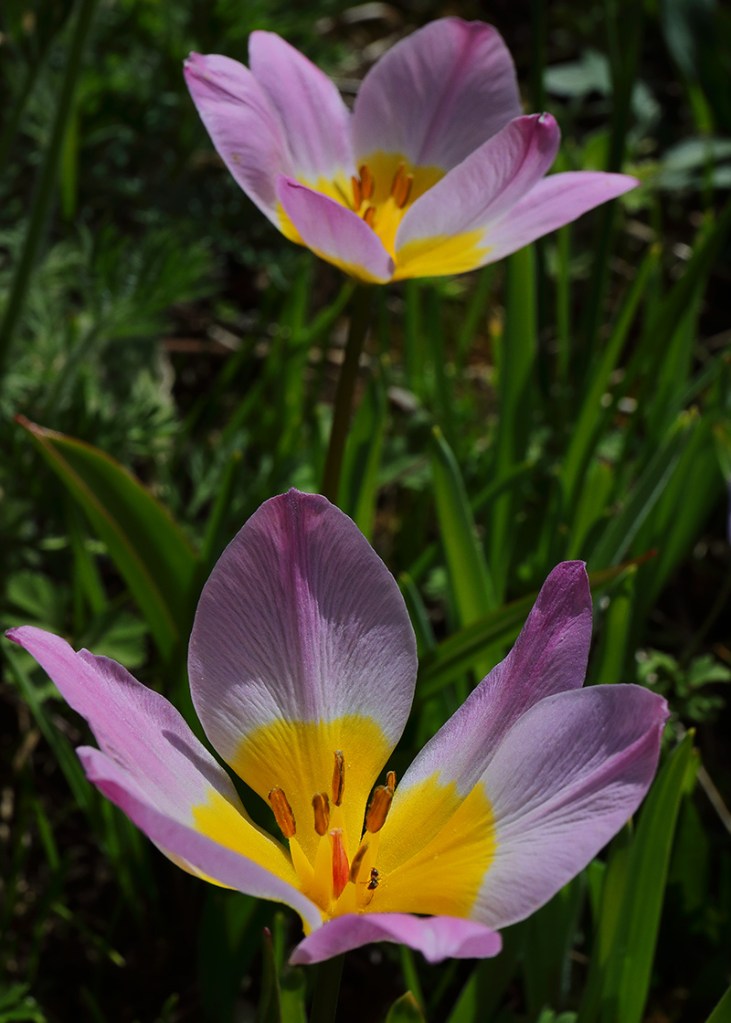
The tulips in my garden are almost all gone now, but I did manage to photograph these flowers of Tulipa saxatilis (Bakeri group) ‘Lilac Wonder’ before they disappeared. This is a low-growing species tulip with small flowers that open into a star-shape in the sun.

As a species (or ‘botanical’) tulip, this one should come back every year and gradually increase over time. However, I have lost a few of the bulbs due to the path beside them being re-laid. (Note to self: keep bulbs away from the path or the edge of the bed in case of future change!)

To me, the name ‘Lilac Wonder’ seems somewhat inaccurate because they look much more pink than lilac. Perhaps lilac is seen as a more desirable (and therefore marketable) colour than pink? Flower colour can be named in rather wishful terms, especially when it comes to blue or black. (I’m thinking of the rose ‘Rhapsody in Blue’, which is a gorgeous purple with magenta tones, but certainly isn’t blue. You can see mine in this post. Then there’s Scabious atropurpurea ‘Chile Black’, which, photographed under strong studio lights, is obviously a deep red, not black. You can see it here.)

Actually, it’s the colour of their centres that I notice most about these flowers. That yellow glows brightly when the sun shines. It makes me think of the yolk of a fried egg…so it’s probably a good thing that the rest of the petal isn’t white!

Pink and yellow flowers of tulip 'Lilac Wonder'

Happy in the Shade: Brunnera

Blue flowers and green and white variegated leaves of Brunnera macrophylla 'Alchemy Pewter' (Siberian bugloss)

NB: A note for WordPress Reader users – you need to click on the title of the post again to come out of the reader and go to the post itself. This allows you to see the whole of the top photograph. (Otherwise you may see just a tiny section!)

Here are more tiny flowers from my garden, again they’re blue. (I’m sure you’re not surprised, given my love of blue and purple.) This week’s plant is Brunnera macrophylla ‘Alchemy Pewter’ (also known as Siberian bugloss). You may be thinking that its flowers look very like forget-me-not (Mysotis) and you’d be right, because they are closely related. Brunnera and Mysotis are both members of the borage family, as is the Pulmonaria from last week’s post.

Brunnera’s blue flowers are very pretty and an excellent source of pollen and nectar for bees and other pollinators. But it’s the leaves (shown below) that these plants are most frequently grown for. They can be very attractive indeed, with popular cultivars having heart-shaped leaves with strong silvery variegations on a bright green background. Some plants have leaves that are almost entirely silver.

There are other colours, however. You can find green-leaved cultivars such as ‘Betty Bowring’, which has white flowers, or golden-leaved plants, including ‘Diane’s Gold’. Then there’s the self-explanatory ‘Variegata’, whose green leaves are splashed with a soft creamy white. But, to me, these are not as lovely as the plants with silver-variegated leaves.

After seeing brunnera’s beautiful leaves in a garden that I visited, I was inspired to try growing it in a shady spot in my own garden. It’s a plant that prefers a moist soil, so I have to be vigilant and take care to water it when the ground gets very dry. So far it is looking good, but I have my fingers crossed for it to survive if we have a very hot summer! 🍃

The variegated leaves of Brunnera macrophylla 'Alchemy Pewter'
The variegated leaves of Brunnera macrophylla ‘Alchemy Pewter’