Summer Glories: Lilies

NB: A note for WordPress Reader users – you need to click on the title of the post again to come out of the reader and go to the post itself. This allows you to see the whole of the top photograph. (Otherwise you may see just a tiny section!)

Lilies are amongst the most glorious flowers in summertime. As a kittycat owner/servant, I don’t grow them in my own garden because they’re highly toxic to cats, but I do enjoy seeing them elsewhere.

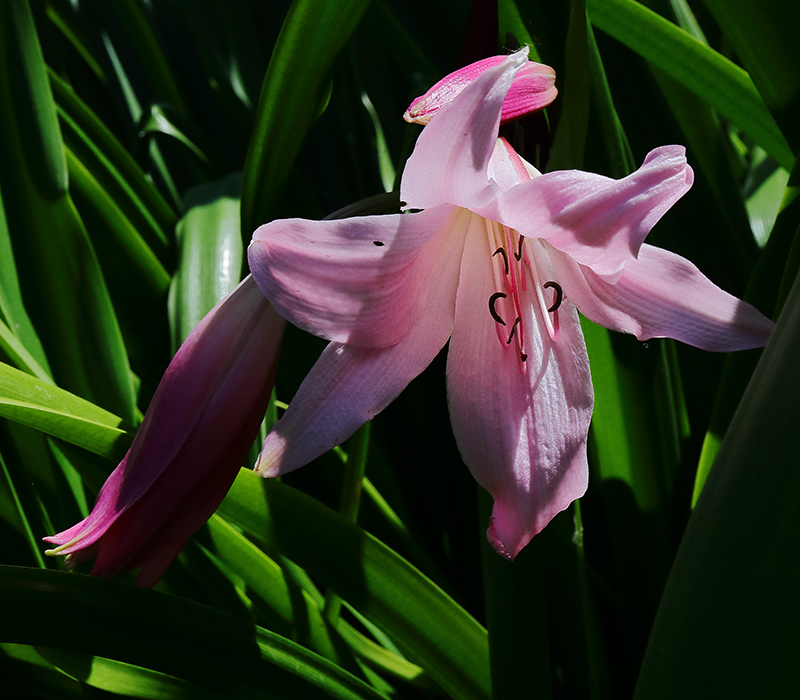
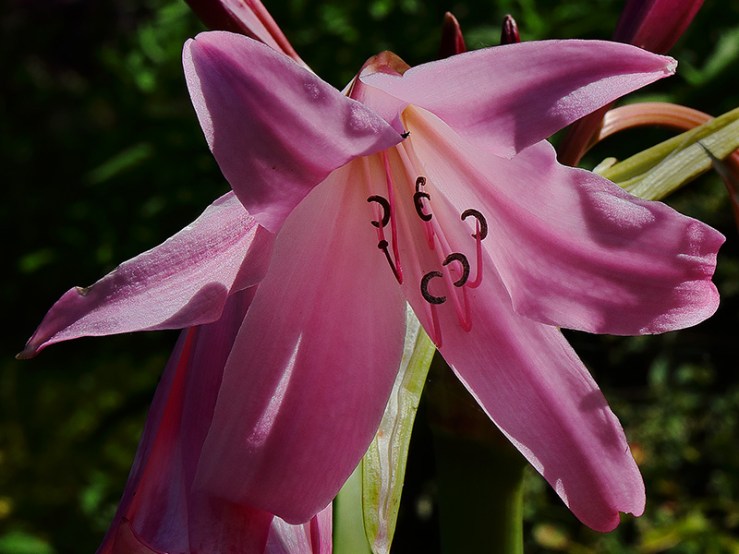
The colours in lilies can be fabulous and look especially rich and vibrant in the sunshine. The deep pink lily in the top picture really stopped me in my tracks when I saw it. It’s a colour that I would love in my own garden (maybe I’ll find it in some other plant). This was one I simply had to photograph, and, luckily, it was just near enough in the border for me to take a reasonable close-up.

A yellow lily photographed close up.
A yellow lily, glowing in the sunshine.

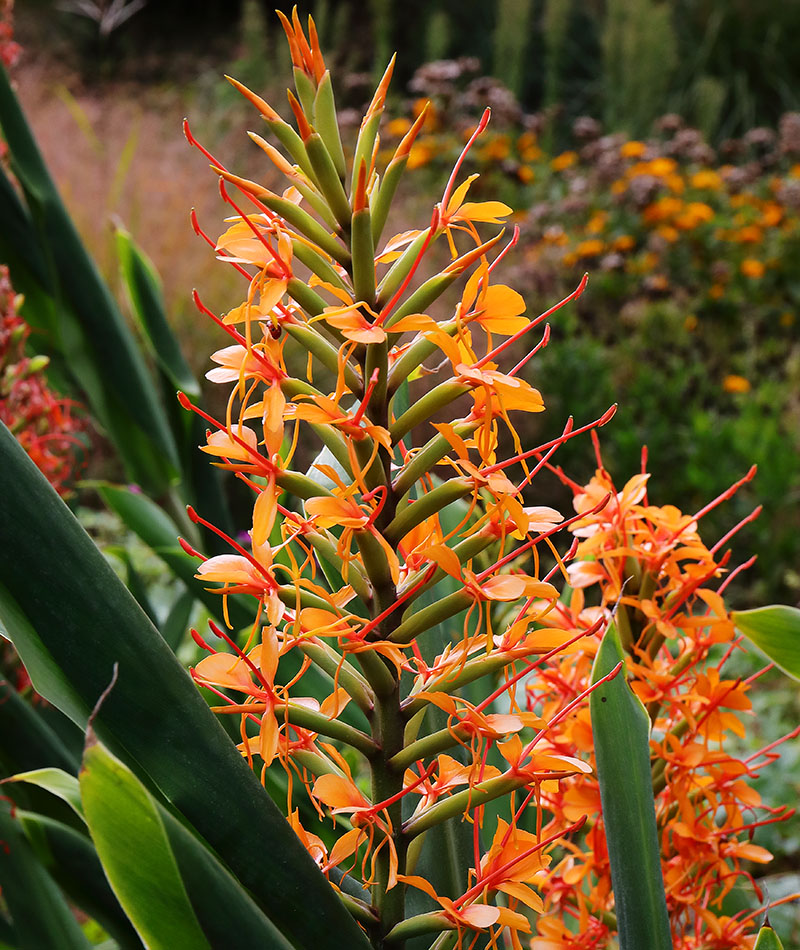
Yellow is a colour I like in my garden if it’s not veering towards orange. I prefer a clear, sharp, lemony yellow or a pale and delicate one. The colour of the lily above would be fine, and particularly lovely when light shines through the translucent petals. Most of the yellow in my own garden at this time of year comes from anthemis daisies and two varieties of evening primrose. (There’s also a recently-added pale yellow Iceland poppy, which I am hoping will seed itself around. It’s too small yet to make much impact, but it’s the daintiest little thing.)

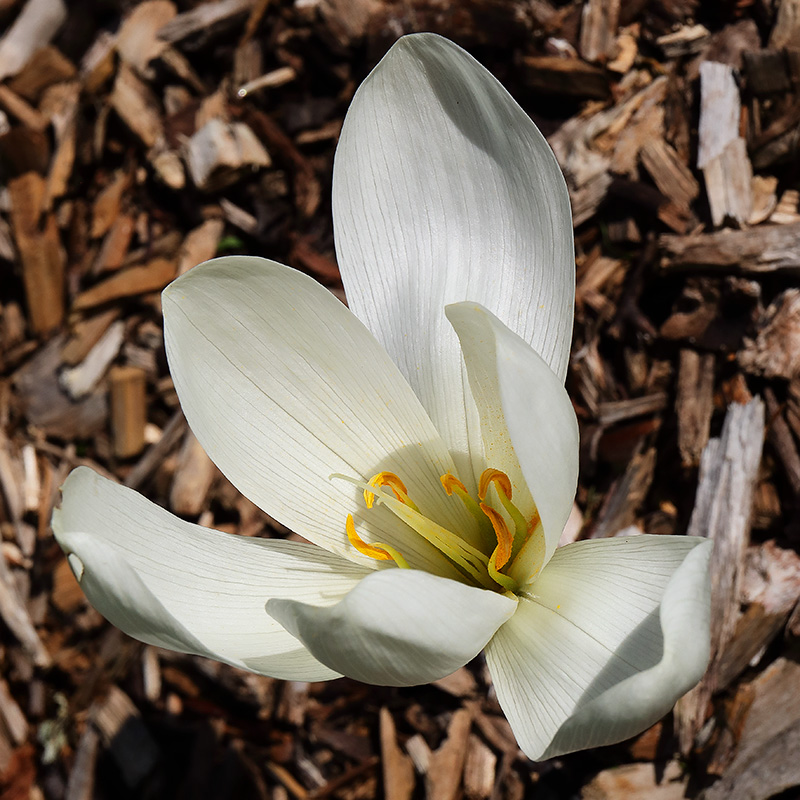
Of course, lilies do white exquisitely well too. Delicate but sensuous, the symbol of purity throughout history and loved for its beauty…I had to stop and photograph this one too. If it wasn’t for their toxicity, I would grow lilies. But, even when I no longer have a cat of my own, I probably won’t. That’s because I’d like to know that I can enjoy the company of any of my neighbours’ cats without worry. So these are not for me, but I do think they’re divine .

A white lily in full flower.

Wild Beauty: White Campion

White campion (Silene latifolia) in flower

NB: A note for WordPress Reader users – you need to click on the title of the post again to come out of the reader and go to the post itself. This allows you to see the whole of the top photograph. (Otherwise you may see just a tiny section!)

These pretty little flowers are white campion (Silene latifolia), a wildflower that likes the well-drained soil in my garden. The plants have seeded themselves here and there, probably arriving from the nearby field edges.

I have pulled out one or two of them, but only if they’re crowding another plant, or in some other unsuitable position. In the past, I think many gardeners would have regarded this plant as a weed, but over recent years, we’ve become interested in having wildflowers in our gardens.

Now we are seeing both the beauty and the value to wildlife of these unexpected gifts from nature. White campion is a good source of nectar and particularly good for moths, who are attracted to its night-scented flowers. The related red campion (Silene dioica, shown below) is more attractive to bees and other daytime pollinators. (I don’t have this one in my garden. The photograph was taken in a wild area of a garden I visited.)

Another relative of white campion is bladder campion (Silene vulgaris). These two look very similar, except that bladder campion has an inflated calyx (the part behind the flower petals) that looks like a tiny balloon and has a much rounder shape than that of the white campion. It gives an interesting look to the plant, however, to my mind, the flowers of white campion are more attractive, especially when covered with raindrops. I hope that any moths around here will think so too!

The small pink flowers of red campion (Silene dioica or Lychnis dioica)

Watery Delights: Miniature Waterlilies

A miniature red waterlily is surrounded by lily pads and duckweed.

NB: A note for WordPress Reader users – you need to click on the title of the post again to come out of the reader and go to the post itself. This allows you to see the whole of the top photograph. (Otherwise you may see just a tiny section!)

It can be difficult to get close enough to waterlily flowers for a decent photograph when they’re growing in a pond. My own pond is awkward to get at and taking a close-up photograph of the pink waterlily there risks a ducking for both me and my camera. (I should change the layout to make access easier.)

It was a plant photographer’s treat to come across these miniature waterlilies growing in large containers recently. The garden we were visiting wouldn’t have had room for a big pond, so the owners had found a good solution to allow them to grow these beautiful plants. It also allowed me to get right up to the waterlilies to photograph them.

A white waterlily flower surrounded by lily pads and duckweed.
A white waterlily flower is in the process of opening.

These small waterlilies looked stunning in their big pots. Grown in this way, they’re easy to keep clear of blanket-weed and debris, presenting a perfect picture to the onlooker. Because they can be enjoyed at close quarters, every small detail of the flowers can be seen and appreciated.

I don’t know what the particular cultivars are here. A look around the online sellers shows that a good variety of colours are available, lots of red and a number of pinks, yellows, white and even orange. Seeing these has made me wonder if I should try one in the shallow water of my own pond. I don’t know the name of the waterlily that’s already there – it came from a friend’s pond a few years ago. I suspect that it should really be in a bigger pond and deeper water, so it may not last here for long. If it does grow too big, one or two of these small waterlilies might be a better choice in the long run. (You can see my pink waterlily here.)

A miniature red waterlily is surrounded by lily pads and duckweed.
A red waterlily is surrounded by lily pads and duckweed.

Buzzy Sunday

Buff-tailed bumblebee (Bombus terrestris) on catnip (Nepeta) flowers.

NB: A note for WordPress Reader users – you need to click on the title of the post again to come out of the reader and go to the post itself. This allows you to see the whole of the top photograph. (Otherwise you may see just a tiny section!)

You may have noticed that my usual weekly post arrived on Friday instead of today – if you missed it, it’s here. (I messed up and published instead of scheduling. Somehow I got distracted because at the same time I was trying to connect my social media accounts to my blog posting. Oops!)

Anyway, here’s a lovely little bumblebee to let you know what’s going on. Hopefully I’ll be back to normal next Sunday! And there’s a little bit of good news – my garden is buzzing with more bees than last summer, probably because of the warmer weather. 🐝

Lurking in the Shadows: Arisaema

Flowers of Arisaema candidissimum

NB: A note for WordPress Reader users – you need to click on the title of the post again to come out of the reader and go to the post itself. This allows you to see the whole of the top photograph. (Otherwise you may see just a tiny section!)

Visitors to Fullers Mill can rely on it as a place to see unusual plants. Recently I saw these flowers of Arisaema candidissimum (AKA ‘Jack in the pulpit’ or cobra lily) there, growing in a shady space under some trees. This is the first time I’ve seen this particular plant, although I’ve previously seen a darker arisaema in this garden.

It’s an odd-looking flower, with a tubular, curved spathe that is striped with pink inside. (Sometimes they can be plain white inside.) The outside of the spathe has a subtle green stripe and the leaves are large, strongly veined, and a lush green, which gives the plant a very exotic, tropical look. I’ve read that the flowers have a sweet scent, but couldn’t get close enough to them to experience it for myself. (These photographs have had quite a bit of cropping.)

Arisaema is not a plant that I’m likely to try in my own garden, given that it prefers a rich soil with plenty of humus (although I am working on that one). It also needs reliable moisture and dappled shade (not much of either of those here). I could try to grow arisaema in pots, but I’d prefer not to have something that would resent drying out – it’s too hot here these days!

It’s good to be able to enjoy the sight of an unfamiliar plant when I’m out on a garden visit. Fuller’s Mill is a garden that has rather different conditions to mine, even though it’s not far away from us, so there’s always something that we can’t grow here.

(You can see the darker Arisaema in this post.)

Flowers of Arisaema candidissimum
The pink-striped tubular spathes and large green leaves of Arisaema candidissimum give it a tropical look.

A Prickly Presence

Eryngium giganteum (eryngo, giant sea holly) in flower, showing the silvery bracts and tiny greenish flowers.

NB: A note for WordPress Reader users – you need to click on the title of the post again to come out of the reader and go to the post itself. This allows you to see the whole of the top photograph. (Otherwise you may see just a tiny section!)

Amongst all the frill and froth of a summer garden, it’s interesting to see the more sculptural presence of a plant like eryngium. Its spiky leaves contrast with the delicate petals around it, while their silvery sheen is an attractive compliment to any flower colour.

I have the much smaller Eryngium planum (blue eryngo) in my own garden, but it doesn’t have the same impact as this Eryngium giganteum. It’s a plant that I would like to make room for here, and I’m having fun imagining what I might pair it with. Small flowers held on long, airy stems could look interesting. I’d like to see what it would look like with the ‘butterflies’ of gaura floating around it and with another, dark-coloured plant to contrast with both. Or perhaps with the small spires of a blue-flowered veronica for a variation in both shape and colour…the possibilities are many.

This particular plant looks like it may be either ‘Miss Wilmott’s Ghost’ or its improved version, ‘Silver Ghost’. For those who haven’t heard the story, Ellen Wilmott loved this eryngium so much that she used to sprinkle the seeds secretly in the gardens she visited – resulting in silvery surprise plants later on. Whether the story is true or not, it remains a popular myth (and possibly the earliest version of ‘guerrilla gardening’).

This handsome plant would be a very welcome surprise in my own garden, but, in the absence of ghostly seed-sprinklers, I think I’ll need to go and buy my own. It’s a short-lived perennial or biennial which self-seeds in areas that suit it, so if I do plant it, I will probably find plenty of seedlings to keep it going. Perhaps Miss Wilmott would have approved.

Eryngium giganteum (eryngo, giant sea holly) in flower, showing the silvery bracts and tiny greenish flowers.
Eryngium giganteum, showing the silvery bracts and the still-green flowers, which will turn blue as they mature.

Pick of the Purples

Dark purple bearded iris flowers

NB: A note for WordPress Reader users – you need to click on the title of the post again to come out of the reader and go to the post itself. This allows you to see the whole of the top photograph. (Otherwise you may see just a tiny section!)

Purple flowers always get my attention. They may be dark and dramatic, like the irises above, or as delicate and pretty as the iris below. I saw (and admired) these on recent garden visits…and, of course, I wondered if there was any chance of finding space for them in my own garden.

I believe the bearded iris in the top photo may be ‘Superstition’. (An internet image search gives a variety of colourings for that cultivar, but most resemble this plant closely.) The darkest of flowers are borne on stems around 3ft high, making a great contrast with pale-coloured flowers. For even more contrast, neighbouring planting could be something light and delicate, with a haze of small flowers to counteract the visual weight of the larger iris flowers.

The second iris is the one I’d most like to grow here. Veining on flower petals is something I love to photograph and this is a beautiful example. The dark – almost black – purple against the white makes me think of ink on paper and the effect of the lines feels almost calligraphic. Such elegance! I like the way the veining is much softer on the standards, with just the palest lilac-purple tracery on the white ruffles. This plant appears to be Iris variegata var. reginae (AKA Iris germanica ‘Variegata Reginae’). I’ve never seen this iris before, so I haven’t seen it for sale around here, but if I do, I’ll be very tempted. (Or I could just buy it online…)

Iris variegata var. reginae

The petals of Iris variegata var. reginae have dark, calligraphic lines of inky purple on a white base.

Floral Favourites

A pink and cream flower of peony 'Bowl of Beauty'

NB: A note for WordPress Reader users – you need to click on the title of the post again to come out of the reader and go to the post itself. This allows you to see the whole of the top photograph. (Otherwise you may see just a tiny section!)

Around here, villages and towns have ‘open gardens’ in the summer. That’s a day when they will have a number of gardens that are open to visitors in aid of local charities. It sometimes means a lot of walking and (even with the maps we’re given) there can be a bit of detective work to find the gardens. Despite that, it’s a fascinating exploration of other people’s gardens and a fun way to get to know the local area better.

You soon see what the favoured plants for the season are too. At this point in the year there were no surprises. Our latest garden walkabout demonstrated the unmatched popularity of roses, the most-loved flower in UK gardens. Other must-haves were irises, alliums and lavender – all expected garden staples for June. (And all plants that I grow too.)

Some of the most frequently-grown of the plants were ones that we don’t have in our own garden. We saw beautiful peonies in a number of the gardens we visited, all at their frilly best. It seems that the two familiar lovelies here (‘Bowl of Beauty’ above, and ‘Sarah Bernhardt’ below) are very much cherished by our local gardeners. It’s easy to see why, and it’s a great pleasure to be able to enjoy the sight of flowers that we would otherwise miss out on. (It may even push me to create a space for a peony or two here…)

A pink flower of Paeonia lactiflora 'Sarah Bernhardt'
A pink flower of Paeonia lactiflora ‘Sarah Bernhardt’ is not yet fully opened.

Still Going Strong

A dark purple-blue Siberian iris flower (Iris sibirica)

NB: A note for WordPress Reader users – you need to click on the title of the post again to come out of the reader and go to the post itself. This allows you to see the whole of the top photograph. (Otherwise you may see just a tiny section!)

On my visit to Fullers Mill earlier this week, I was surprised to see that their Siberian irises were still flowering. Not only that, but they had plenty of buds still too. Those in my own garden finished flowering a little while ago. (I’ve even had enough time to deadhead them all.)

Blue flowers of Iris sibirica 'Silver Edge'
Iris sibirica ‘Silver Edge’

Perhaps the reason for the variation in flowering time is that my garden has been hotter and the soil more dried out. At Fullers Mill there are a lot of trees, which must help to give some shelter from the heat of the sun. There seems to be more moisture in the soil there too. Whatever the reason, it was a pleasure to be able to see these lovely plants still in flower.

The deep purple-blue tones of the iris in the top photo captivated me. The petals have a velvety look, enhancing the opulent effect of the flower. (I’d love to have enough space to grow this one – probably ‘Shirley Pope’ if anyone else has the same thought.) I recognise the second iris (photo above) because I have it in my own garden. It’s ‘Silver Edge’. Unfortunately, my plant is sulking a bit after having been moved, but hopefully it will recover and flower more prolifically in future.

A white Siberian iris
This white Siberian iris may be ‘White Swirl’.

Another guess, aided by a Google photo search, makes me think that the white and yellow iris above may be ‘White Swirl’. Although it’s the blue irises that capture my affections, the calm and elegance of white is often exactly what’s needed to create a quiet space away from the hurly-burly of bright colours.

The photo below (from a different garden) shows a planting of blue Siberian irises, with perfect (unchewed by slugs and snails) hostas and pretty candelabra primulas. Oh, how I would love to be able to re-create this in my own garden! (Especially if I could have the stream that’s hiding behind it too) I can always dream!

Siberian irises in a waterside planting with hostas and primulas
Siberian irises look perfect in a waterside planting with hostas and primulas.

Other People’s Flowers

White wisteria flowers against a blue sky.

NB: A note for WordPress Reader users – you need to click on the title of the post again to come out of the reader and go to the post itself. This allows you to see the whole of the top photograph. (Otherwise you may see just a tiny section!)

With spring comes the urge to start visiting gardens again. It’s fascinating to see what other people grow and how they put their gardens together. Naturally, I take my camera too, though perhaps not to the smaller gardens if it seems intrusive. (It would be all too easy to forget that a garden is part of someone’s home.)

Being able to photograph other people’s plants helps me to sustain this blog – something that would soon become impossible if I had to rely on the limited number of plants in my own garden. I do photograph my plants from year to year, but I try to wait a couple of years or more before posting the same plants here. So getting out on a garden visit is essential to bring some variety to this blog.

White flowers of Rubus 'Benenden' (Tridel berry, ornamental bramble).
Rubus ‘Benenden’ shows that it’s related to roses.

I sometimes find plants that surprise me, as in the sheer size of the white wisteria in the top photo. It was growing up a huge conifer and pretty much covering the whole tree. Whether, or how, it was ever pruned I don’t know, but it looked most impressive. The same garden provided a little mystery for me too, in the shrub shown in the photo above. Something I’d never seen before. I could see that the flowers looked like they could be related to the rose family, but that the leaves were a different shape. A little bit of Googling suggested to me that it is Rubus ‘Benenden’, an ornamental bramble and a member of the Rosaceae.

Centre of a white peony flower
The centre of a white peony in all its frilly glory.

My next two plants are more familiar to me…above is a white peony and below is Romneya coulteri, the Californian tree poppy. Both of these are fairly frequent sights in the gardens we visit, but plants we’re unlikely to grow in our own garden. That’s partly through lack of space, and partly through not having quite the right growing conditions. (The Romneya can spread and would take more room than we have to spare, while peonies prefer a richer and heavier soil than we could give them.)

Visiting gardens lets me experience the beautiful plants that other people grow and often gives me the opportunity to to photograph something different to help fill this blog. (As all my fellow bloggers will know, blogs are always hungry for more material, especially photos.) On the day that this is posted, I’m planning to visit one of my favourite gardens in our area (Fullers Mill). If all goes well, the resulting photographs should keep this blog fed for a little while! 🌼

A white flower of Romneya coulteri (Californian tree poppy).
Romneya coulteri (Californian tree poppy), displaying the large central boss of yellow stamens.