Young and Old: Hellebores

hellebore flowers

NB: A note for WordPress Reader users – you need to click on the title of the post again to come out of the reader and go to the post itself. This allows you to see the whole of the top photograph. (Otherwise you may see just a tiny section!)

A question in response to last week’s post about hellebores has prompted this one. Linda (who blogs at https://shoreacres.wordpress.com/ ) made this comment: ‘What really surprised me was finally figuring out that the green was a sign of aging rather than a sign of ‘youth.’ I assumed the petals were green at first, and then turned rose. But from what you’ve said, the fresh petals are cream colored — is that right?’

In my reply to Linda I said that the flowers turn green as a part of the aging process. Sometimes, however, there is a slight blush of green on the younger flowers too. (That green shows that there is chlorophyll present, which contributes to the plant’s overall photosynthesis.)

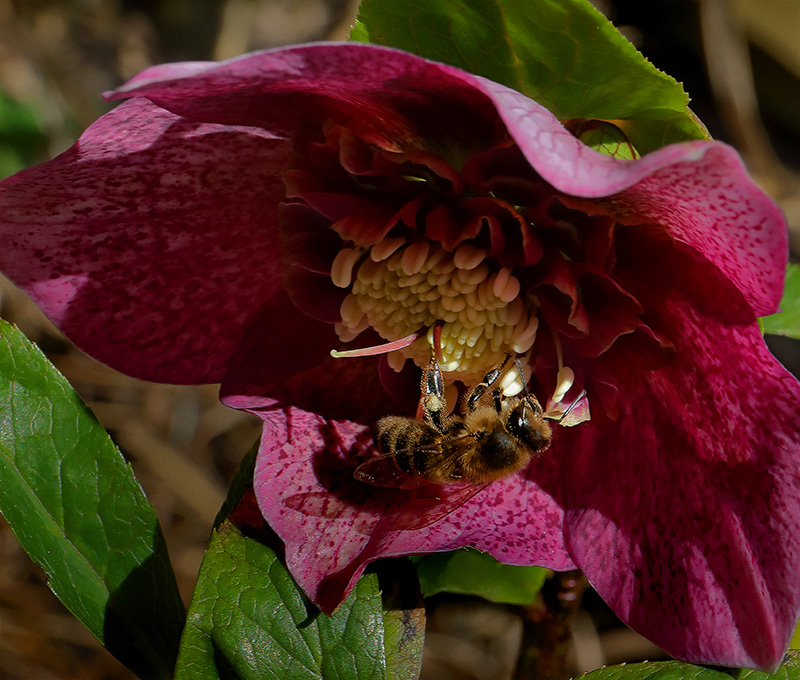
The ‘petals’ of a hellebore are actually sepals. That’s the part of a flower that is normally green and leaf-like, and sits behind the petals. The hellebore sepals turn green after the flower has been pollinated. Some hellebores have sepals that age and darken to a peachy-pink shade, as you can see in my top photo. Whatever their colour, the flowers can last for weeks, with the sepals being more robust than normal petals.

hellebore flowers
An older flower of Hellebore ‘Rosali’ with a paler flower that’s just opened to its left.

You might be wondering why the hellebore has no true petals. In fact, they’re still there, but over time have evolved into the tubular structures arranged in a ring in the centre of the flower. These are the nectaries, which produce nectar to attract any of the wild bees and other insects that may be active during winter or early spring. In the photo above, you can see the ring of nectaries is still on the old flower, but the stamens have dropped off after pollination.

In the bottom photo, you can see that the nectaries have now also fallen off this old flower. That leaves just the carpels that contain the developing seeds in the centre. How different the aging flower looks compared to the younger ones below it! Those still have both their stamens and their nectaries. (In this case I think the nectaries very pretty, like little ruffles with delicate pink stripes inside.) This particular plant does have a greenish tint to the cream flowers, which later become a vivid green.

Oh, and just to confuse things a little, there are green-flowered hellebores. Helleborus viridis and Helleborus foetidus are both native to the UK and have green sepals throughout their flowering period. Then there’s the Corsican hellebore (Helleborus argutifolius), also known as the holly-leaved hellebore because it has spiny leaves. This one has attractive lime-green flowers and I’m tempted to try growing it, both for the novelty of green flowers and for the handsome foliage.

hellebore flowers

Time to Awaken

Deep pink hellebore flower

NB: A note for WordPress Reader users – you need to click on the title of the post again to come out of the reader and go to the post itself. This allows you to see the whole of the top photograph. (Otherwise you may see just a tiny section!)

It’s been wet and miserable outside for a few days, so there’s not much temptation to go outside. However, now there’s a little treat for every time I venture out into the garden. The slight rise in temperatures has encouraged the hellebores to begin to bloom, giving some bright colour under the grey sky.

The photos here are both of the same hellebore – ‘Rosali’ – although the flowers look rather different. (I’ve used photographs from previous years because the flowers of this one are still just in the process of opening.) Looking at the flower colours, you might think they’re different plants, but no, they’re the same one. I must admit, I did wonder if they could really be the same, but last year’s post of Rosali’s flowers convinced me.

I think the difference in appearance is due to a combination of things; variations in the plant from year to year, flower age, and the effect of lighting. The flower in the bottom photo is aging, and you can see the green creeping into what had been the cream colour of the petals. On the other hand, the top photo is of a fairly newly-opened flower, which will probably become more cream as it develops. In the photo, the crimson which usually just edges the petals shows through the whole flower. Probably this is because of the way the strong sunlight is lighting the flower from behind, carrying the deep colour of its reverse right through it.

Earlier I went out to check on this hellebore and was delighted to see a generous mass of dark-coloured buds, with just the first few starting to unfurl. Soon it should have lots more flowers open – enough to make a winter day feel brighter and spring just a little bit closer!

Pink and cream flower of Hellebore Rosali
Hellebore ‘Rosali’ in flower in late winter.

Thawing…for now!

thawed frost drops on winter jasmine

NB: A note for WordPress Reader users – you need to click on the title of the post again to come out of the reader and go to the post itself. This allows you to see the whole of the top photograph. (Otherwise you may see just a tiny section!)

We still have some below-zero nights forecast, but it feels as if the worst of the cold is over. Of course, that feeling may turn out to be entirely wrong, because there’s still plenty of time left for more wintry weather. Despite that, the sight of the early daffodil leaves poking up through the soil and the first hellebore flowers makes it feel like spring isn’t so far away.

Thawing frost created several opportunities in the past few weeks for me to get busy with my camera. The tiny meltwater droplets looked especially clear and they glittered where the sun struck them. Other drops, in dark corners where the defrost was slower, were still half-frozen.

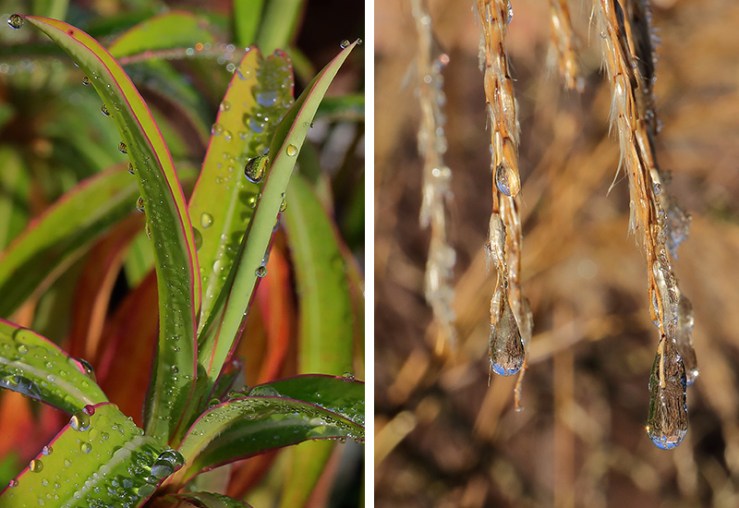
clear drops of thawing frost
Sunshine brings out the sparkle on the drops of melted frost on Euphorbia mellifera leaves and the seed heads of a Miscanthus grass.

Thinking about that clarity in the drops of melting frost made me wonder if they were purer than ordinary raindrops. After all, raindrops pass through the atmosphere, collecting any pollutants along the way, whereas frost is formed from condensed water vapour. So, like a distilled liquid, they should be free of impurities…well, that’s my theory, anyway! In any case, I enjoy seeing the plants here all decked out in these sparkling little beads.

I am very much looking forward to spring; now I’m longing to see new growth and feel the sun warm the air. At the same time, I realise that I should take care to notice winter’s small details and the way that the natural world changes through this period of cold weather. Soon enough, the changes will be those of approaching spring…🌱

Frost thawing on rose leaves.
Thawed frost forming drops around the edges of rose leaves.

Pennies from Heaven

Frosted honesty seed heads

NB: A note for WordPress Reader users – you need to click on the title of the post again to come out of the reader and go to the post itself. This allows you to see the whole of the top photograph. (Otherwise you may see just a tiny section!)

Apparently honesty (Lunaria annua) has around 25 common names. (According to the RHS, you can see their list here.) That’s a lot of names, probably because it’s a plant that has been in our gardens for a very long time. It is known to have been in cultivation in the UK since the sixteenth century and is mentioned in Gerard’s Herbal at that time.

Among these names are several that relate to money, including ‘St Peter’s pence’ and, in an interesting contrast, ‘Judas’s penny’. The names ‘money flower, ‘penny flower’ and ‘silver dollar’ have their origins in the way the seed pods look like coins. The name ‘money-in-both-pockets’ was probably given to the plant for the same reason, but to me, the pods also look like tiny pockets with the coins – seeds – inside. That the seeds are visible through the outer layers of the pods has given rise to the name most of us know it by, the familiar ‘honesty’.

The money-inspired names gave me a fair excuse for the title of this post. (Finding new titles can be hard at times!) But there are many names with other inspirations. ‘Grandpa’s specs’, for instance, which makes me smile, while ‘matrimony’ makes me wonder. (A hopeful name, arising from the plant’s associations with both honesty and prosperity, perhaps?) ‘White satin’, ‘silver leaf’ and ‘satin pod’ are all very descriptive of the central membrane that is left when the outer layers of the seed pods fall away.

But the names that appeal to me most are those that refer to the moon-like appearance of the pods. There’s the Latin name, of course – ‘luna’ means ‘moon’. Then there’s ‘moonwort’ and ‘moon seed’, both of which make me imagine honesty’s tiny papery moons gleaming in the reflected moonlight of an autumn evening.

The seeds have been gathered from the seed pods photographed here, and sprinkled where I’d like the plants to come up in future. Now only the silvery central discs are left and are dripping with slowly thawing frost. To me, they look even more like tiny glowing moons. I see them as little wintry moon-pennies.

In the spirit of honesty, I must admit that I’ve never actually heard anyone use the names mentioned here. Lunaria has always been ‘honesty’ to me. It’s a little sad for old names to die out and be forgotten. They’re part of our culture and the history of our relationship with plants..

Frost melting on honesty (Lunaria annua) seed heads

Asleep in the Shade

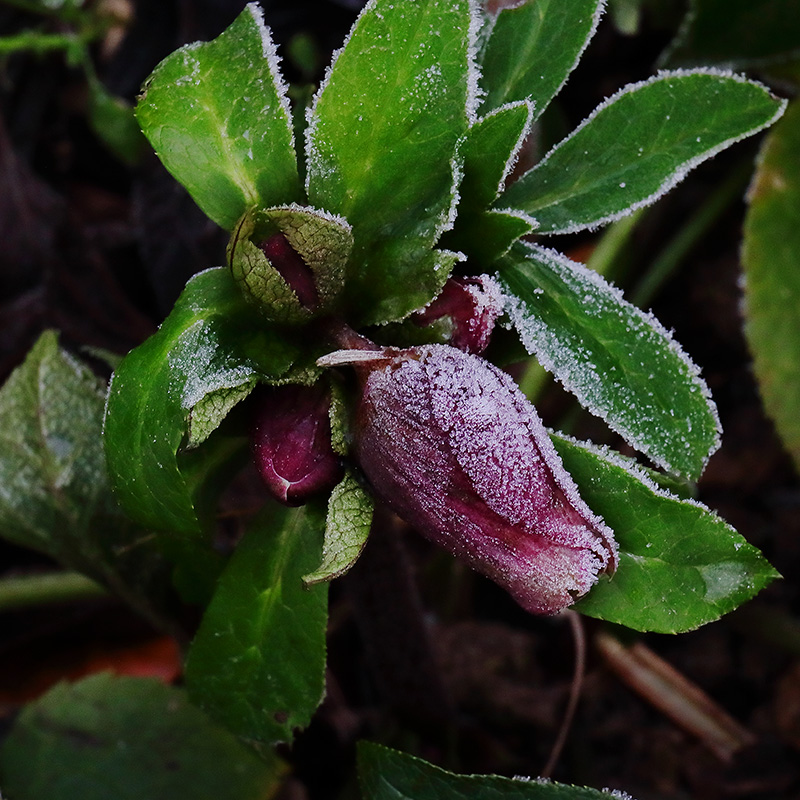
Frosted hellebore buds

NB: A note for WordPress Reader users – you need to click on the title of the post again to come out of the reader and go to the post itself. This allows you to see the whole of the top photograph. (Otherwise you may see just a tiny section!)

During the run of frosty mornings this week, I spent a lot of time photographing plants in the garden. While busy in amongst the icy foliage, I looked down by my feet and noticed that even the hellebores appeared to be frozen. I haven’t seen them frosted before because the areas they’re in are usually too well-protected by nearby shrubs. To my fanciful imagination, they look as if they’re all tucked up, sleeping soundly and waiting for warmer weather.

These hellebores manage to be in flower very early in the year and their presence reminds me that winter won’t be here forever…spring will come! As it happens, the flowers appear to have emerged slightly earlier than they have in previous years. (Up until now I’ve seen them in flower here at the start of February. Perhaps the earlier flowering is because the plants are now becoming more established.) It was still less than halfway through January when I photographed them, so there is likely to be more cold weather for them to face.

Freezing temperatures don’t seem to bother these tough little plants, despite their glamorous appearance. I’m grateful for their resilience. It would be wonderful if all the rest of the plants in the garden could be relied upon to come through winter so well. (But I can only blame myself for the less hardy plants chosen for here. And what would life be without the excitement of a little bit of risk…?)

Frosted hellebore flowers

A Cold Start

Frosted clematis flowers (Clematis cirrhosa 'Landsdowne Gem')

NB: A note for WordPress Reader users – you need to click on the title of the post again to come out of the reader and go to the post itself. This allows you to see the whole of the top photograph. (Otherwise you may see just a tiny section!)

January usually means a change to colder weather here. December can be quite mild and often doesn’t feel particularly wintry to me, but the start of the new year tends to bring a drop in temperatures.

True to form, we have frosty weather here now, so it’s a good time to get busy with the camera. The images here, though, are not from this winter but were taken a couple of years ago. We don’t often get such a heavy frost, so on that glacial morning I photographed everything I could find. (I’m still processing the photos now!) It could be a long time before frost encrusts everything as heavily again. The freezing weather doesn’t last long enough – this was the result of several icy-cold nights.

Right now, the frost is coming and going and I seize the chance to take a few photographs on those cold mornings. It does look as if we might have a run of several sub-zero nights in the coming week, so perhaps the frost will have a chance to build up…I’ll have my camera ready just in case.

(The plants here are Clematis ‘Lansdowne Gem’, which flowers in winter, and the seed heads of Potentilla recta var. sulphurea (sulphur cinquefoil). If you’d like to see what the clematis looked like before the frost got to it, there’s a post about it here.)

Frosted seed heads of potentilla

May Your New Year be Bright and Happy

Frosted flowers of Viburnum bodnantense 'Dawn'

NB: A note for WordPress Reader users – you need to click on the title of the post again to come out of the reader and go to the post itself. This allows you to see the whole of the top photograph. (Otherwise you may see just a tiny section!)

It’s the time when we look back at the old year and forward to the new year. I hope that 2024 has been good to you and that 2025 will be a very happy and healthy year for you. May your New Year celebrations be fun and full of joy and the start of a year that fulfils your hopes and plans. Happy New Year!

Wishing You Joy at Christmas.

Frosted rose 'Rhapsody in Blue'

NB: A note for WordPress Reader users – you need to click on the title of the post again to come out of the reader and go to the post itself. This allows you to see the whole of the top photograph. (Otherwise you may see just a tiny section!)

Wherever you are in the world, and whether Christmas is something you celebrate or not, I hope that this is a time of joy and peace for you. The ‘blogging world’ is a wide and varied one. It encompasses people who are very different from one another, but are brought together by common interests and a sense of camaraderie. I enjoy the relationships that have built up with both those who read my blogs, and those who write the blogs I read, and I wish you all great happiness at this festive time of year. Merry Christmas to you all!

(P.S. The rose is ‘Rhapsody in Blue’, which finished flowering long before now. One year, however, it managed to produce a few flowers late enough for them to get frosted – a photographic bonus for me!)🎄

Caught by a Winter Chill

NB: A note for WordPress Reader users – you need to click on the title of the post again to come out of the reader and go to the post itself. This allows you to see the whole of the top photograph. (Otherwise you may see just a tiny section!)

Most of the flowers in my garden disappear long before December. Unusually, the astrantia (top) managed to hold onto several flowers until well into one winter. Over a couple of very cold mornings it provided me with a delicate little subject for photography, and a good reason for getting very cold fingers and toes!

The scabious in the picture below was newly-planted just a few months ago and still had several buds at the time. I didn’t know if the last ones would open, but this one has. It was just in time to get caught by a heavy frost. The frost didn’t last long – you can see the droplets forming as it melts.

There’s always a chance that the last autumn flowers will get a touch of early frost. I was lucky, however, that these two plants were still in flower when the heavier frosts arrived. There’s often very little left to photograph by that time. The frost lasted well on these flowers because they’re both on the side of the garden that’s shaded from the morning sun. If they’d been over on the sunny side, the frost on them would have melted early, long before I’d have had time to get outside with my camera.

Luck can play a large part in my photography. There are many things that I have little control over and there are also the unexpected surprises that nature brings. I just have to keep my eyes open for them! ❄

A flower of Scabiosa caucasica ‘Fama White’ is covered in a frost that’s just starting to melt.

Frosted Fragility

NB: A note for WordPress Reader users – you need to click on the title of the post again to come out of the reader and go to the post itself. This allows you to see the whole of the top photograph. (Otherwise you may see just a tiny section!)

Frost gives me good opportunities for garden photography in winter, but it’s generally not good news for the flowers in my pictures. The rose photographed last week was robust enough to survive, although it may not open any more fully. Most frozen blooms, however, are left with wilted and sagging petals when they thaw.

That’s not a worry, since the frost will usually just have finished off the last of the flowers from autumn. The plants will flower again next year – if they’re hardy. But there are some that are only borderline hardy and will only survive if the winter doesn’t get too cold for them.

The salvia above (Salvia involucrata ‘Bethellii’) may withstand temperatures down to about -5℃ and this plant managed to come through several winters. A far colder spell than we’ve had for a long time was too much for it, though, and it didn’t reappear the following spring. Some cuttings from the plant did survive that unusually cold period. They are in a huge pot that’s part of a collection of containers that my husband has planted up to go in front of the house. There it’s sheltered by the house wall. It benefits from a sunny, south-facing position and the warmth that radiates from both the wall and the paved driveway below it. This just shows how microclimates can vary within a garden!

The little daisy below was, I think, Rhodanthemum ‘Moondance’. (The leaves belong to the plant behind it.) It should have coped with winter. In this case it was probably the heavy winter rain that killed it rather than the cold. It’s a Mediterranean plant that likes good drainage. Here our summers are normally very dry, but, awkwardly, our winters can be rainy and wet. That means that I do sometimes lose plants if I haven’t given them good enough drainage. I think I’m lucky that so much does survive! 🌿