Dainty and Delightful: Small-Flowered Clematis

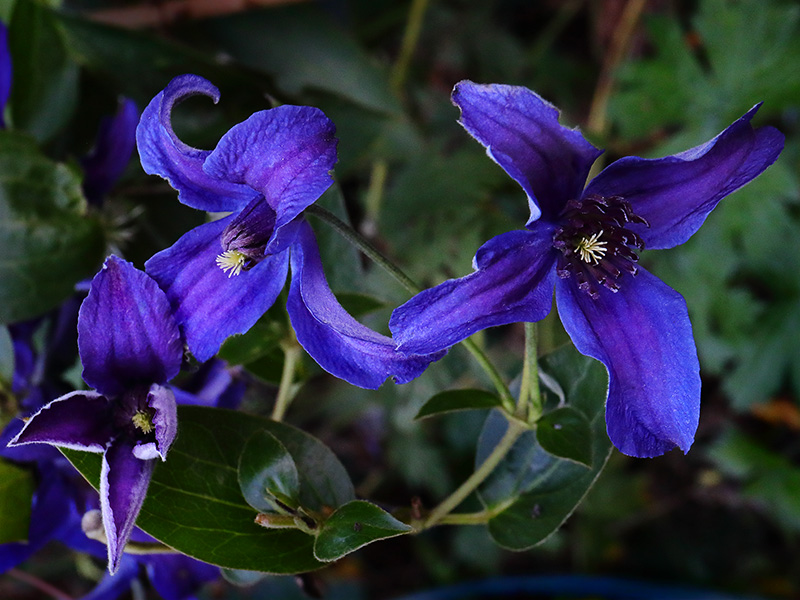
Small-flowered blue clematis

NB: A note for WordPress Reader users – you need to click on the title of the post again to see the full photograph. (Otherwise you see just a tiny section!)

Clematis are amongst my favourite flowers – probably pretty close to the top of the list. The large-flowered varieties are sumptuous, with rich colours and beautiful flower forms. I’m always tempted to grow more of these wonderful plants. But the smaller-flowered cultivars are just as appealing. They may also be easier to fit into a wide variety of garden styles.

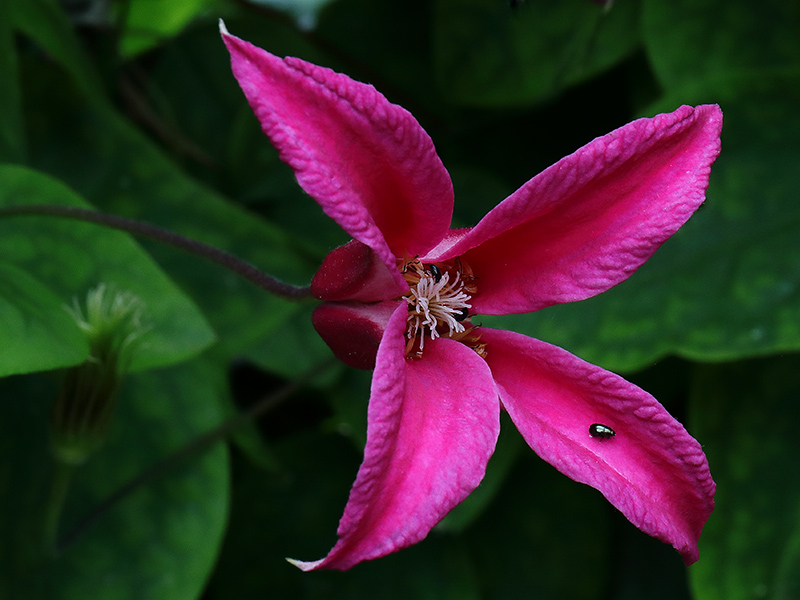
The large-flowered clematis can sometimes feel too showy for a more naturalistic planting style, or in a wilder part of a garden. Here the smaller-flowered clematis may be easier to use, sitting more comfortably with simpler, less highly-bred flowers. I can easily imagine the lovely little clematis in my top photograph growing through shrubs in my own garden. (I’d need to find out what it is first. This is a plant I saw in a garden I visited this year, as is the pink clematis below.)

Pink clematis flower
A stunning pink – possibly Clematis texensis ‘Princess Diana’

The pink clematis would need a bit of thought about positioning because it is such an eye-catching colour. It is very elegant, though, and wouldn’t look out of place in an informal planting. The deep blue/purple clematis below would probably look good almost anywhere. This one is ‘Sapphire Indigo’, bought many years ago at a plant fair. I haven’t seen it for sale anywhere since (although it is available online), which surprises me. It’s a lovely plant which sprawls rather than climbs, so I prop it up by leaning it against the branches of nearby shrubs. I should try to propagate it because I’d love to have more of it around the garden.

Clematis 'Sapphire Indigo'
Clematis ‘Sapphire Indigo’ in my own garden

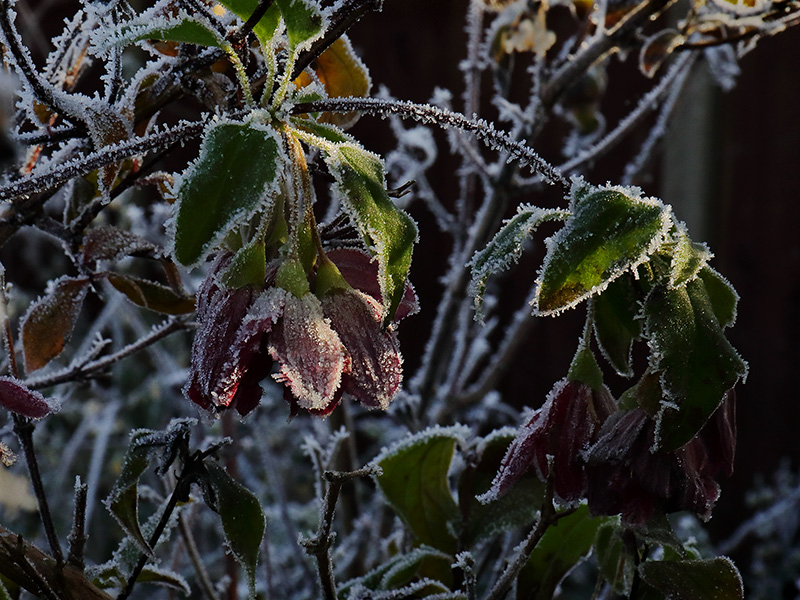
The last clematis in this little gathering is ‘Lansdowne Gem’, which flowers in wintertime. It got thoroughly frosted last winter, which worried me a bit because I wasn’t sure if it would be hardy enough to cope with a long cold period. It does appear to have survived though, because I can see some new shoots appearing now. (Mine goes dormant in the heat of summer, so only starts to show signs of life around this time.) This is a pretty clematis, with dark red, occasionally speckled, flowers that are like little bells hanging down from the shrubs it climbs. Its flowers are something cheering to look forward to in the depths of winter.

(You can see more pictures in my post about ‘Lansdowne Gem’ here.)

Frosted flowers of Clematis 'Lansdowne Gem'
Frosted flowers of Clematis ‘Lansdowne Gem’

Late Sunshine

Yellow lily

NB: A note for WordPress Reader users – you need to click on the title of the post again to see the full photograph. (Otherwise you see just a tiny section!)

Officially it’s autumn, but summer is determined to cling on here. Temperatures are breaking records for this time of year (over 30C for several days). So it feels appropriate to post a collection of bold yellows this week, a colour that makes me think of a child’s drawing of the sun.

The yellow lily demanded my attention as it gleamed in the sunlight and flaunted its brilliant colour against a dark background. It, and most of the other flowers here, were photographed during garden visits. (This spectacular lily was photographed at Fullers Mill, which I have posted about several times: here, another here, and again here.)

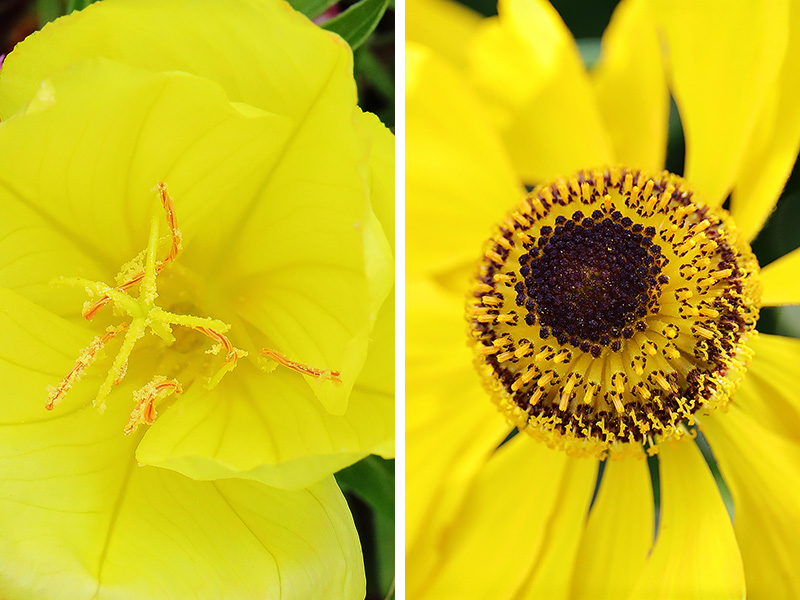
Left: evening primrose Right: yellow helenium
Left: evening primrose, right: helenium (sneezeweed)

The helenium (above, right) and the Anthemis daisies (below) were also photographed in other people’s gardens. I’ve visited a lot of gardens this year, making up for previous years when Covid caused the cancellation of many garden-openings. It has been a lot of fun and a great way to see plants I don’t grow here, many new to me.

The evening primrose shown above is the one flower here that was photographed in my own garden. It is Oenothera macrocarpa (Missouri evening primrose, bigfruit evening primrose), a low-growing perennial that sprawls happily in the dry soil here. The flowers of this evening primrose are a bit darker and a more lemony yellow than the taller evening primroses that also grow well here. Their flowers are larger too, opening in the afternoon and persisting well into the next morning before fading.

The last plant in this post, Anthemis tinctoria, is one that also grows in my own garden. Mine, however, is ‘E.C. Buxton’, which has much paler petals (actually ray florets). I don’t know what the cultivar in the photo here is, but I was impressed by the richness of its colour. Just the thing for a post inspired by sunshine!

Anthemis tinctoria
Anthemis tinctoria

Dark and Dramatic

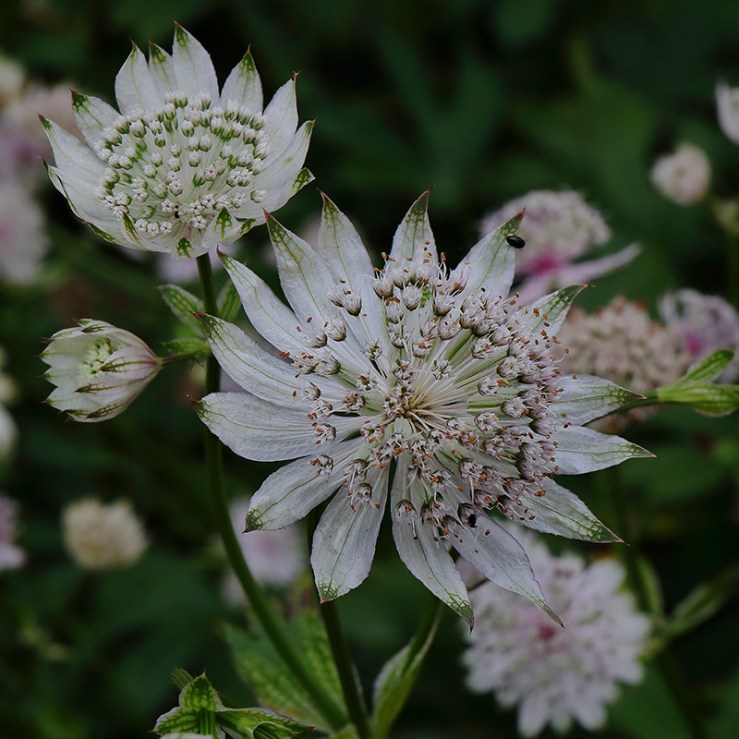
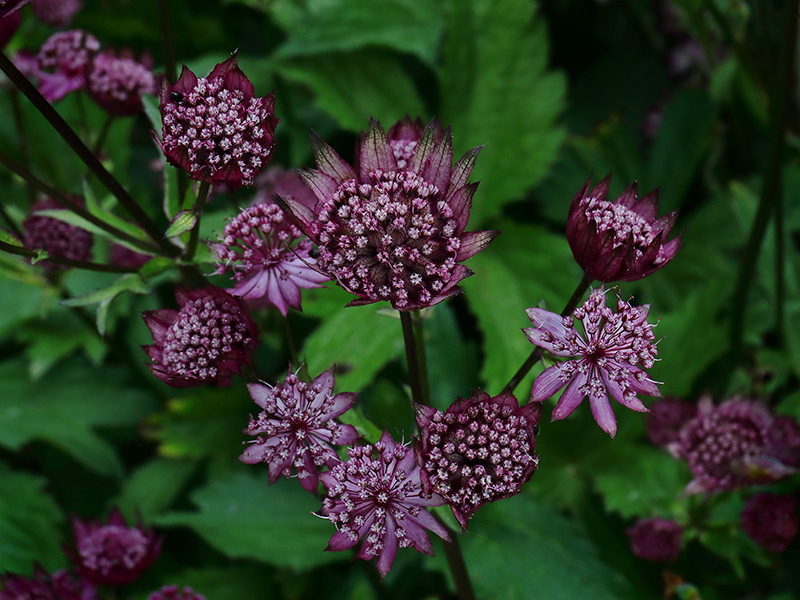
Dark crimson Astrantia flowers

NB: A note for WordPress Reader users – you need to click on the title of the post again to see the full photograph. (Otherwise you see just a tiny section!)

There are a couple of white astrantias in my own garden which are very pretty and delicate-looking. Lovely as they are, they don’t have the sultry and rather dramatic good looks of this astrantia, photographed in a garden I visited recently.

I don’t know the name of this particular astrantia cultivar. A quick look around with Google has shown me that there are now many cultivars in a range of pink, red and burgundy shades. All are stunningly beautiful, so you can imagine how tempted I am by them…nothing surprising there, hehe!

Fortunately for me, they don’t take up a huge amount of space, so I should be able to fit one or two in here. (But they do prefer a more moisture-retentive soil than we have, so a good addition of compost would be necessary first.)

Dark flowers and foliage have a strong appeal for me. They help to prevent borders from looking a bit too sweet and add a suggestion of mystery and moody allure. My only problem will be deciding which of the dark astrantias to go for!

Dark crimson Astrantia flowers

Similar but Different: Orange and White Lilies

Orange and white lily flower

NB: A note for WordPress Reader users – you need to click on the title of the post again to see the full photograph. (Otherwise you see just a tiny section!)

It’s a fascination to me to see how diverse cultivars of the same flower species can be. If you think of something like dahlias, for instance, there’s a massive variation between their flower types. But even flowers that might sound the same when described can actually look quite different.

The lily flowers here are similar enough that when I reviewed my pictures after a garden-visit, I initially thought I had two sets of photos of the same plant. As soon as I paid them proper attention, I realised that they were in fact quite unalike. They have only superficial similarities of colour and flower shape.

At first glance, both lilies have swept-back (‘recurved’) petals and an orange and white colouration to their flowers. But a second look shows that the orange of the lily below is much softer and more muted than the one above. Additionally, the top lily has dark speckles on its petals and little bumps called ‘papillae’. (I’ve read that these papillae are important, because they secrete a substance that attracts insects. They are also exploited by lily breeders to produce a different look to flowers.)

I don’t grow lilies in my own garden (because I have cats and lilies would be a danger to them), so I don’t often get the chance to look at lily flowers very closely. Seeing and photographing them in other people’s gardens feels like a little voyage of exploration – one I enjoy tremendously! 🙂

Orange and white lilies

Into the Blue: Agapanthus

Agapanthus flower head (blue)

NB: A note for WordPress Reader users – you need to click on the title of the post again to see the full photograph. (Otherwise you see just a tiny section!)

I’ve been very busy in both house and garden recently and haven’t had so much time for photography here. (There has been a lot of change in the garden, which has created plenty of work to do. At the same time, work on the house has meant lots of rearrangement and change there too.)

But I have made time to visit a number of local gardens, so I’ve photographed flowers in them instead. That’s good, because it allows me to photograph plants I couldn’t otherwise. However, this is one that I should have been able to photograph at home. I left it a bit late, and my own agapanthus had too many flowers that were starting to go over. Happily, I’d already photographed these in someone else’s garden.

These flowers are actually a stronger colour than mine, which are a much paler blue. The individual flowers are a good size too. I find that my agapanthus can sometimes produce very small flowers and I wonder if it’s because they aren’t getting enough moisture. (I should probably water them more often!) If that’s the case, the extra rain this summer will have been a big help.

The blues of agapanthus are absolutely lovely, but they have other colours that are beautiful too. I’ve seen a fabulous deep purple that I like (‘Black Jack’), and I’m also tempted by some of the paler purples and a white tinged with blue…I would need a bigger garden to fit them all in! 🙂

Agapanthus flower head (blue)

Missing but Not Forgotten: Penstemons

Magenta-purple penstemon flowers

NB: A note for WordPress Reader users – you need to click on the title of the post again to see the full photograph. (Otherwise you see just a tiny section!)

These penstemons aren’t growing in my own garden, but they do remind me of plants that I grew here until last winter. Sadly, the colder-than-usual winter killed off several penstemons that I’d had for a few years.

Penstemon ‘Raven’ is very similar to the plant above, with flowers of a fabulously deep purple that has a magenta tinge. I miss it! There will certainly be more of it in the garden again, but in future I’ll more careful to take cuttings that can be kept somewhere away from the frost.

Another of the penstemons that I lost was ‘Hidcote Pink’ – a very pretty salmon-pink that was a bit different to the other shades of pink here. (My other pinks have a bit more blue in them.) It would be welcome in the garden again. But perhaps the most missed of the lost penstemons is deep red ‘Garnet’, which I’d had for years. This one might perhaps have made it through the winter if it hadn’t already been struggling a little. (The ground level where it was growing had been disturbed a bit when building the pond. This meant that the ground around it drained much more and became a bit too dry for the plant…oops!)

I love the rich colours and the attractive markings inside the throat of penstemon flowers, so I’ll be keen to grow more of them in future. (Bees love them too, and it’s amusing to see their little furry bottoms sticking out of the bell-shaped flowers – a bonus!) At this stage of the summer, I may leave it to next spring to buy more plants though. And I will have to be more careful about protecting them from harsh winter weather. The effort will be worth it to see these beauties in my garden again.

Red penstemon flowers

Garden-Visit Treats: Daylilies

Crimson daylily (Hemerocallis)

NB: A note for WordPress Reader users – you need to click on the title of the post again to see the full photograph. (Otherwise you see just a tiny section!)

Wandering around other people’s gardens gives me a chance to see flowers that I don’t have in my own garden. It’s one of the pleasures of visiting them, especially the large and well-stocked gardens that can afford to grow a wide range of plants. Sometimes I find plants I’ve never seen, except possibly in photos, and other times I see plants I can’t grow at home.

Daylilies (Hemerocallis), like those shown here, are too toxic to cats for me to risk growing. (Like Lilium species, daylilies are deadly to cats, even in small amounts – so much so that the water from a vase that the flowers have been in is toxic to them.) So seeing them elsewhere is a rare opportunity for me to photograph these beauties.

If it wasn’t for the risk to my cats, I might be tempted by the vibrant colours of daylilies, especially the fabulous purple shade of the flower above. As it is, I will just have to admire them when I see them, and perhaps be lucky enough to be able to photograph them too.

Orange/red daylily (Hemerocallis)

An Oddity!

Daucus carota showing aberration of flower

NB: A note for WordPress Reader users – you need to click on the title of the post again to see the full photograph. (Otherwise you see just a tiny section!)

From year to year, many of the flowers in my garden are the same. Most are perennials, but there are also the annual and biennial self-seeders that have become established here. So each season has a familiar look, with perhaps a few recent additions or a few losses.

Something did manage to surprise me this summer – the unusually enlarged flower head of the wild carrot (Daucus carota) pictured above. This is the mixed deep-red to white variety ‘Dara’, which I sowed a few years ago. A biennial, it has been self-seeding here ever since. The shape of this particular flower has gone very much awry, perhaps due to disease or an attack by an insect.

The flower should be a simple umbel (a shape like the frame of an upturned umbrella), like the one shown below. If you look at the structure of it, you’ll see that the ‘umbrella frame’ of stems each end in a similar structure, but in miniature. (These are known as ‘umbellules’ or ‘umbellets’ and make up a ‘compound umbel’.) The normal flower in the picture below is in the process of opening into the flatter shape of the maturing flower head.

The newly-emerging wild carrot flowers
This normal wild carrot flower has just begun to open.

So what has happened to produce the strange flower head here? Somehow it has produced an extra ring of smaller umbels around the central umbel. Each of these has then gained a ring of umbellules on longer stems than usual, giving the appearance of being surrounded by tiny satellites. It is as if the instruction for growing into a normal flower have become corrupted and caused repeats in the flower’s structure. Whatever the cause, I’m intrigued by this flower and I’m wondering how it will develop. What will happen when it tries to fold into the ‘nest’ shape that the seed-heads normally become? If it survives long enough, I’ll let you know what happens… 🙂

You can see more pictures of how wild carrot normally looks and develops here.

A single Daucus carota flower head, showing an aberration in its structure.

Pure Fluff: Cardoon Seed Heads

Cardoon seed head

NB: A note for WordPress Reader users – you need to click on the title of the post again to see the full photograph. (Otherwise you see just a tiny section!)

Some seed heads draw more attention than others. The sight of the huge fluffy seed heads of the cardoon (Cynara cardunculus), growing in a garden I visited was irresistible. The seed heads appealed as a subject to photograph, and because I always want to stroke the soft hairs attached to the delightfully ethereal seeds. (I didn’t stroke them though. I couldn’t get close enough!)

I’m not the only one attracted to the cardoon’s seeds. In winter, finches will eat the seeds and, when spring comes, if any the soft down remains, it may be used to line nests. Long before that stage, the huge purple thistle flowers are visited by many bees and other pollinators. The cardoon flowers have lots of pollen and nectar and can appear over a long period (around June to September). This makes the cardoon a valuable plant for bees and it would be a great addition to a garden planted with pollinators in mind.

Cardoons grow to a large size – up to 6 feet tall by about 4 feet wide. That’s a bit big for my own garden. (Space is becoming an issue here.) If there was room for one, I’d certainly consider growing one of these plants because, in addition to the bee-friendly flowers, they also have spectacular deeply-cut silvery leaves. However, it might irritate my neighbours if those floaty little seeds were to land and then produce new plants all over their gardens!

Cardoon seed head
Seeds are beginning to float away from this cardoon seed head.

A Meadow Beauty: Sainfoin

Flower of sainfoin (Onobrychis viciifolia)

NB: A note for WordPress Reader users – you need to click on the title of the post again to see the full photograph. (Otherwise you see just a tiny section!)

The flowers of sainfoin (Onobrychis viciifolia) were sprinkled throughout the meadow that I wrote about in last week’s post. It’s a plant that I had never seen before. I was enchanted by the spikes of delicate pink flowers with darker pink veining, so I took the opportunity to photograph it.

Reading up about this grassland plant afterwards, I discovered that it is a native of Europe and Asia. Sainfoin is an ancient forage crop grown to feed cattle, sheep and horses. It fell from favour in modern times but is apparently making a comeback. The plant has several benefits, including controlling worms in grazing animals and improving the quality of the soil by fixing nitrogen. (The common names of ‘healthy hay’ and ‘holy hay’ reflect the benefits to livestock.)

But it’s not the usefulness to animals that caught my attention. I’m far more interested in the benefits that sainfoin offers to bees and other pollinators. Apparently sainfoin produces large amounts of both pollen and nectar, making it very attractive to pollinating insects, including bumblebees and butterflies.

This suggests that it would be worth growing in a selection of wildflowers for a semi-wild area that will be a habitat for wildlife. It’s an idea that appeals to me greatly, but I would need to be able to fit my wild patch into a small space. A possibility for next year… 🙂

Sainfoin (Onobrychis viciifolia) with ox-eye daisies