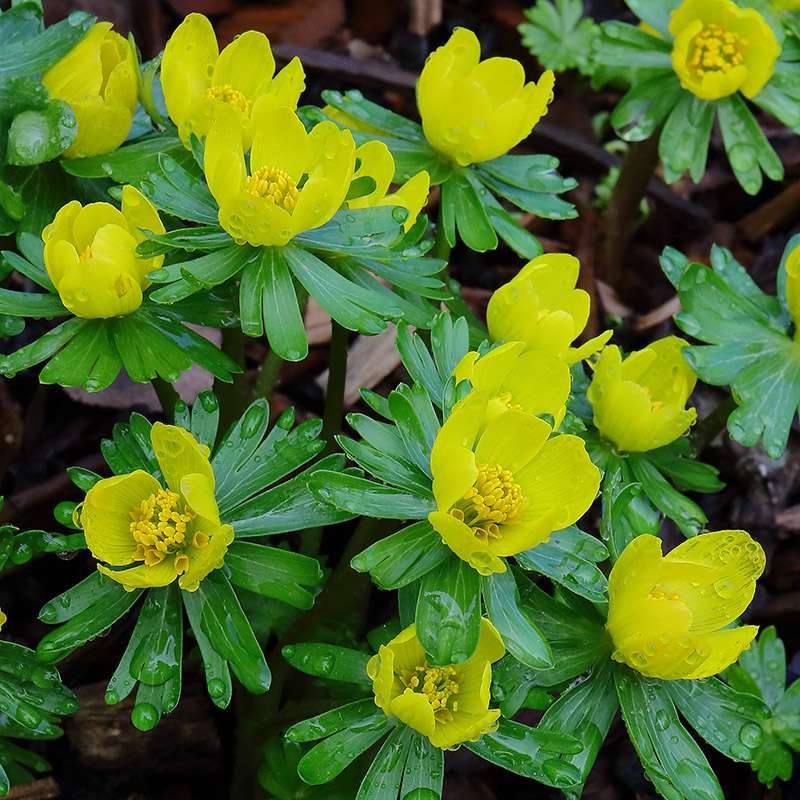
NB: A note for WordPress Reader users – you need to click on the title of the post again to come out of the reader and go to the post itself. This allows you to see the whole of the top photograph. (Otherwise you may see just a tiny section!)
Spring is still some way off in the UK but a few flowers are gradually emerging. My favourite gardens at Fullers Mill are open during February to let visitors come and see the snowdrops, so of course I have visited to photograph those. But I was delighted to find these sunny midwinter beauties growing there too. These are winter aconites (Eranthis hyemalis), one of the earliest plants to flower in the year.
As you might guess from the appearance of the yellow flowers, the winter aconite is a member of the Ranunculaceae, the buttercup family. If you look closely at the top photograph, you can just see the tubular nectaries around the stamens…a feature shared with the closely-related hellebore. Flowering at the same time as hellebores means the two plants can be used in some very striking combinations. I’d love to try growing winter aconites with either a pure white hellebore or a very dark purple one. (Winter aconites do look lovely with snowdrops, and I’ll be able to share a photo of that combination in my next post.)
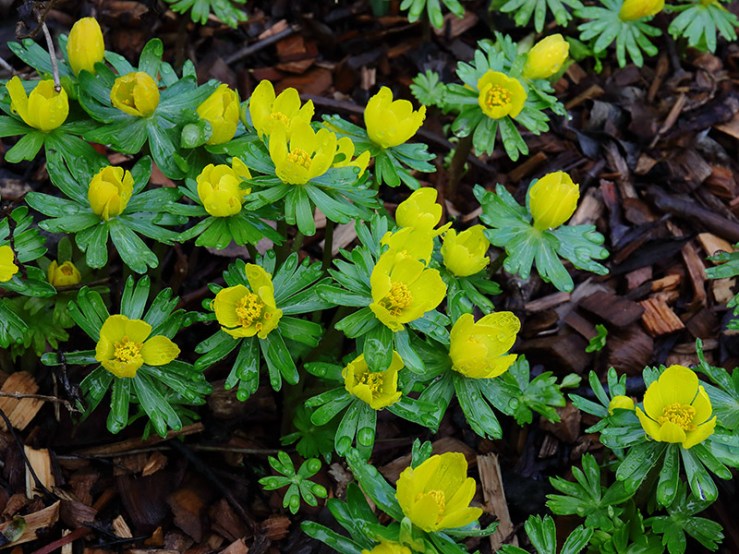
This plant is versatile. It will grow in woodland and shady conditions or in sunny spots, preferring reasonably moist, fertile soil. If it’s happy with the site, it can spread over large areas, but it doesn’t take over for long as the leaves die back in late spring.
Appearing from late January makes this flower an excellent source of nectar and pollen for the first queen bumblebees to emerge from winter hibernation. It is valuable for honeybees too, and for any other pollinating insects that are active early in the year, making it an asset to a wildlife garden. Clearly, at a time when there are not many plants in flower, the winter aconite is more than just a pretty face!

 Ann Mackay: Inspired by Nature
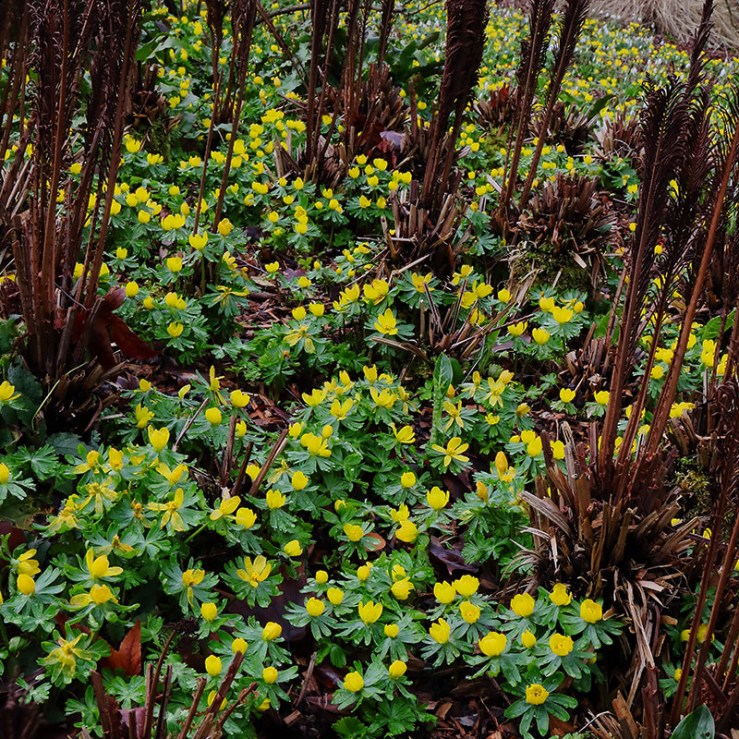
It’s good to see pictures of a group and then a colony of those bright yellow flowers. Clearly you’re an acolyte of the aconite.
LikeLiked by 1 person
I was impressed by the swathes of these yellow flowers. I didn’t expect them because I’d seen no hint of the plants later in the year. (They die back by the time the garden is on its normal opening times.)
I’m a ‘devoted follower’ of plants in general, hehe!
LikeLike
I’ve seen Winter Aconite in some of the gardens I’ve visited but didn’t know much about it. Definitely one to plant in the garden, especially as it looks like it doesn’t mind a bit of shade.
LikeLiked by 1 person
If you can find it as a growing plant, it would be easier to establish than growing from dry corms. (I’ve read that they may be difficult if the corms have got very dry.) Once you have some in the garden, they’ll self-seed to give you more. 🙂
LikeLiked by 1 person
That’s good to know. Thank you!
LikeLiked by 1 person
Those aconites are beautiful. I especially like the way the shape of the flower is echoed by the arrangement of the leaves. The combination of flower and leaves suggested the rays and disks of members of the Asteraceae.
LikeLiked by 1 person
The pretty leaves are a bonus. 🙂 I have a couple of winter aconites in the garden, possibly self-seeded from somewhere. (I didn’t plant them, but I must plant some more.) Like hellebores, the ‘petals’ are actually sepals, while the petals have involved into tubular nectaries, like those on hellebores. I’m impressed by how varied plants are!
LikeLiked by 1 person
They are a delight. I love how they spread when they are happy.
LikeLiked by 1 person
They are a lovely sight at this time of year…I’m hoping to get some established in my own garden.
LikeLike
Sigh… the few aconites I used to have seem to have disappeared altogether this year. I did notice that the lesser celandines have come back though, despite my digging them out each year! I don’t dislike the flowers, but they take over.
LikeLiked by 1 person
I fight with lesser celandines every year too…they spread like anything! I like having some wildflowers in the garden, but not if they have ambitions to take over! I have only a few aconites, possibly self-seeded, but fewer than last year. Maybe it was too dry in summer – plenty of rain now though!
LikeLike