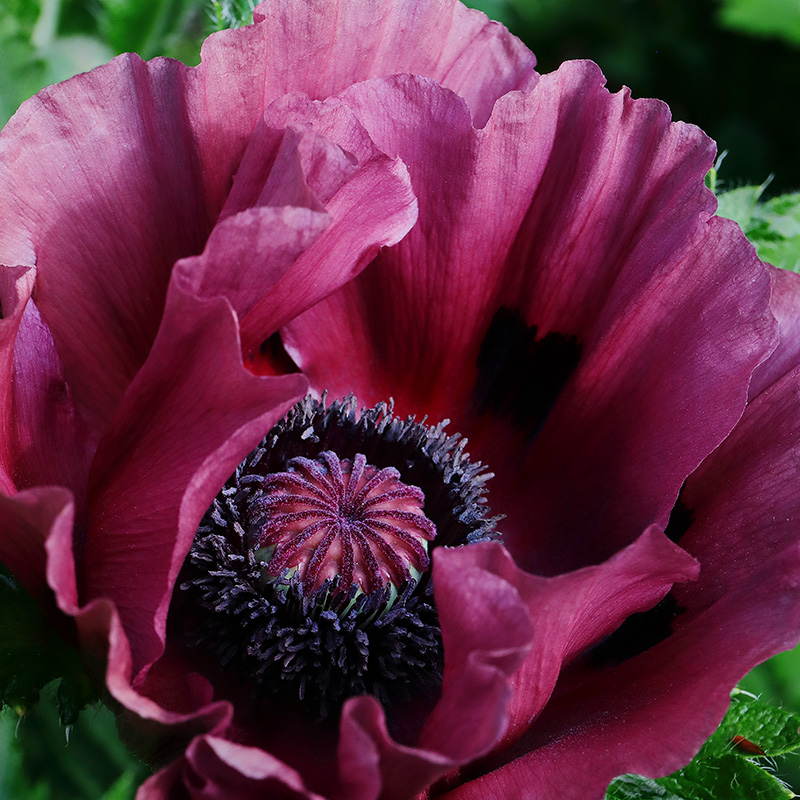
NB: A note for WordPress Reader users – you need to click on the title of the post again to come out of the reader and go to the post itself. This allows you to see the whole of the top photograph. (Otherwise you may see just a tiny section!)
Although it’s still only May, there are summery-looking flowers already open in my garden. Roses, irises, geraniums and verbascum are in flower right now, but it’s the oriental poppy ‘Patty’s Plum’ that makes me feel that the days are about to be much warmer and brighter.
There’s something about the look of these big, gaudy flowers that suggests they should be basking under blue skies and sunshine. Instead they are having to cope with this week’s wet weather. Fortunately I photographed the flowers here before they got a bit flattened by the heavy rain and there are plenty more unopened buds, so more flowers to come.
I wondered if this poppy had come into flower slightly earlier this year and took a look at the dates that I’ve photographed it over the last few years. This year it was May 13th, for the two years before it was around May 23rd and in 2021 it was 28th May. So perhaps the flowering time has crept forward a little.
It certainly feels as if there’s a headlong rush towards summer by all of the plants in the garden. Keeping up with everything that needs to be done is pretty much impossible at this time of year. Even so, it’s important to stop gardening for a little while and take some time to just enjoy the flowers while they’re at their best.

 Ann Mackay: Inspired by Nature
Ooh, lovely. I have recently bought 3 of these poppies, but I don’t know whether they will flower this year. I keep checking that they aren’t being eaten!
LikeLiked by 1 person
I think the hairiness and roughness of the leaves should help to protect them – this one doesn’t have problems with being nibbled. (Hope I’m not tempting fate – and S&S – here!!) It took a couple of years or so for this one to get well established, it seems happy now. 🙂
LikeLiked by 1 person
I had a look this morning and out of the three, two have buds. But they need to grow taller!
LikeLiked by 1 person
They will! 🙂
LikeLiked by 1 person
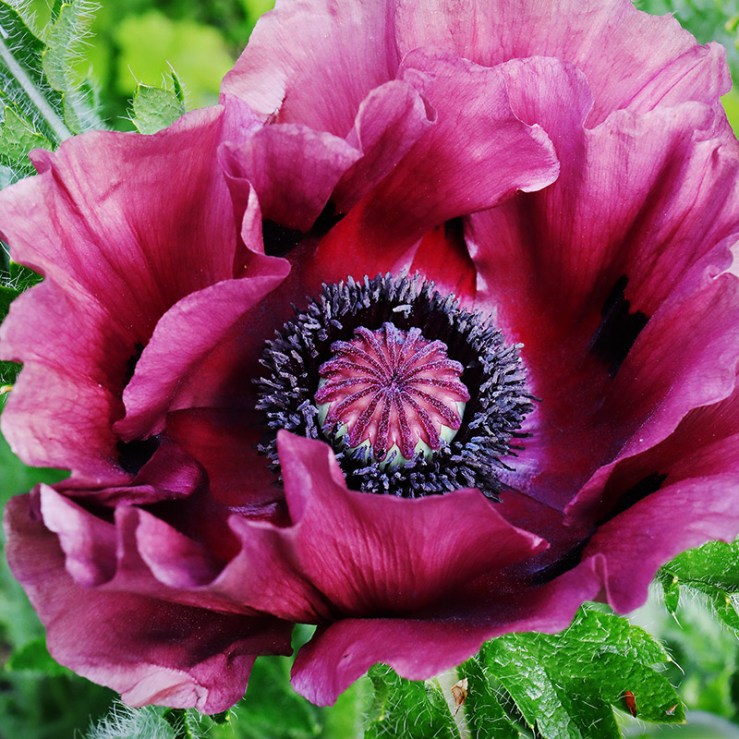
I couldnât help counting the ridges radiating from the poppy flowerâs center. Do you know if the number is always 15?
>
LikeLiked by 1 person
While these two flowers are the same, the number can vary. Your question intrigued me, so I looked at the poppies in a post from a few years ago: https://annmackay.blog/2020/06/21/crumpled-silk-oriental-poppies/ The top photo is the same plant and you can see that there are more ridges in the centre (17), while the different cultivar in the bottom pic has just 14. Now you have me wondering if the flowers on a poppy all have the same number of ridges in a year, or whether they vary…will have to find time to count them! 🙂
LikeLike
WordPress wouldn’t let me comment here on your blog, but I was able to comment by replying to the e-mailed version of the post (except for apostrophes getting misinterpreted).
LikeLiked by 1 person
That’s weird but then, WordPress seems to go a bit odd at times. I hope it’s temporary!
LikeLike
It was the same problem I had a couple of weeks ago. WordPress insisted I had to log in even though I was logged in and could post on other blogs.
LikeLiked by 1 person
Hmm, I’ve changed the comments settings, so maybe it will work OK for you now. To be honest, I don’t really understand what it does…argh!
LikeLike
Lovely!! Here rain clouds are heralding rainy season!
LikeLiked by 1 person
Quite the opposite here – the rain is over and we’re baking in the sunshine today. Who knows what we’ll get next week!
LikeLiked by 1 person
The question about the number of ridges made me smile. It seems to me that those ridges would act the same as petals on a flower. For example, the so-called ‘ten petal anemone’ often has ten petals, but just as often it can have eight, or twelve, or even fourteen. The prairie nymph usually has three petals, but I’ve found examples with four petals, and six. It’s natural variation, not nature working off a spec sheet!
That aside, this is a gorgeous flower. The color is so rich; it looks like the color of a fine wine.
LikeLiked by 1 person
Hehe…your comment has made me smile! I reckon nature would just chuck a spec sheet away and get on with being delightfully inventive! 🙂
LikeLiked by 1 person
My non-botanist’s take (which therefore may or may not be correct) is that in some species the genetic code calls for the same number of elements every time; even so an anomaly can still occur once in a blue moon, as in the well-known four leaf clover. By contrast, in other species the genetic code allows from the outset for a varying number of elements, as in the “ten”-petal anemone you mentioned.
LikeLiked by 1 person
I once had one of those beautiful poppies from some seeds down the lane. That’s the last time it appeared either in my garden or down the lane where I originally found it. At the moment I have a crop of ever increasing orange oriental-looking poppies but goodness knows where they sprang from. Maybe things are making up for lost time with the damp windy winter and spring we’ve had. Or is it just a trend of things starting to flower earlier, later or just differently?
LikeLiked by 1 person
Poppy seeds can last for a very long time in the ground, so maybe those orange poppies were in your garden many years ago. It could be a little bit of your garden’s history come back again! Here I think the weather was a lot warmer than usual a few weeks ago so that might have made things flower a bit earlier. The extra warmth and sun has certainly helped things to flower well.
LikeLiked by 1 person
That is a lovely colour, Ann. And the details of the center of the poppy are fascinating to see. I hope your garden will cope with the sudden changes in weather that seem to be the new norm.
LikeLiked by 1 person
Thank you Tanja! The colour is lovely, but when the flowers fade they turn an unappealing brown, so I usually deadhead it. I notice that there are still some unopened buds waiting to burst into flower. 🙂
LikeLike