Little Pretenders: Hoverflies

A marmalade hoverfly on red scabious.

This year I’d like to make my garden a bit more wildlife-friendly. (You can see my previous posts about gardening for bees – Bees’ Needs: Flowers! and Blue (and Violet and Purple) for Bees – by clicking on the links.)

Bees are not the only pollinators that I’d like to encourage in the garden. Hoverflies are important for pollination and their larvae have a valuable role as predators of aphids and other garden pests. (There are always plenty of greenfly around here, so there should be plenty to keep any hoverfly babies munching!)

It can be easy to confuse hoverflies with bees or wasps. (They don’t sting but they mimic stinging insects so that birds are less likely to try eating them.) If you look at the photo of the honeybee below, you can see that there are differences between the common ‘marmalade hoverfly’ and the bee.

Bee on tithonia 2587
Not a hoverfly! This one is a honeybee (on a tithonia flower).

The bee here is generally a bit more furry-looking. (You can just see that there is a hairy patch on the front of the bee’s head and that its thorax is also hairy. Compare that to the thorax of the hoverfly, which is shiny and looks almost metallic in the sun.) The hoverfly has much shorter antennae and has just two wings, whereas the bee has four wings. (It’s hard to see that in the photo. You might just about be able to spot the separation at the back edge of the two wings on the nearest side of the bee.)

However, there are many other types of hoverfly (over 270 in the UK) and some look much more like bees than these. There is a difference that will help you tell which is which. Hoverflies have large eyes which cover the front and side (i.e.most) of their faces. A bee has eyes on the side of its face and they are much smaller and an oval shape.

It’s likely that some of the different ‘bees’ I thought I’d spotted in the garden were really hoverflies. Maybe I’ll learn to identify some of them… if I can move quick enough to photograph them!

Hoverfly on giant scabious
Hoverfly on Cephalaria gigantea (giant scabious).

It’s very worthwhile to grow flowers that will attract these useful little beasties. They have shorter tongues than bees, so aren’t attracted to some of the deeper, bell-shaped flowers (e.g. foxgloves and penstemons) that bees like. Instead they prefer more open flowers where the nectar and pollen is easy to get at. They really like the daisy types like the aster below and umbellifers such as the fennel and wild carrot that grow in the garden here. One of the flowers that I often find them on is the scabious – as you can see from the photos.

I like watching hoverflies dart around amongst the flowers. They are fast and very agile (even flying backwards) and they add to the feeling of life and energy in the garden. I hope to see lots more of them this year – and maybe a few new ones – even if they do fool me into thinking that they may be bees or wasps!
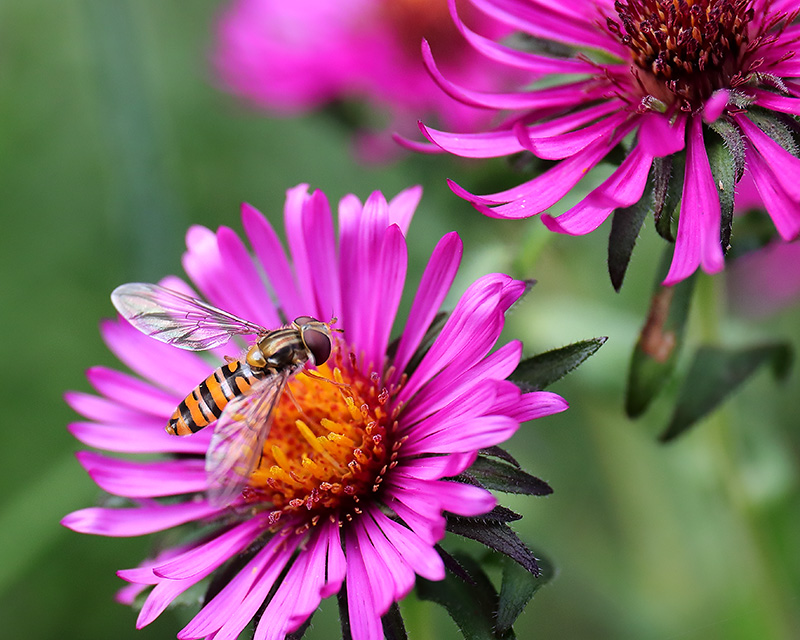
Hoverfly on aster 2468
Hoverflies like daisy flowers, like this aster.

Indoor Photography: Flowers with Studio Flash

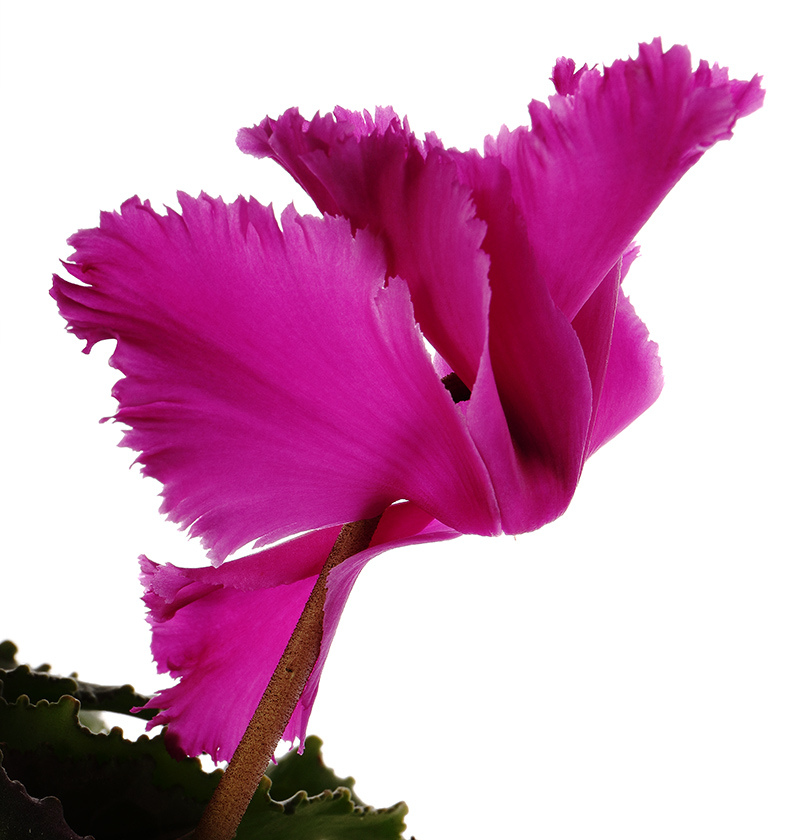
Ruffled pink cyclamen flowers

During the winter I’m glad to be able to photograph plants indoors. It feels good to be able to stay warm and dry! And life is much easier when there’s no need to worry about the flower you’re trying to photograph waving around in the wind.

More importantly, taking photos indoors means that there is plenty of light available to me. I have a very small studio space set up in the house, complete with flash lighting, which allows me to be busy taking photographs at any time of day.

Cyclamen-4197
I wanted the light to catch all the little crinkles and curled edges on the petals of the flower.

The photographs here were taken with a very simple setup. The white background is created using a small ‘light table’, which is basically a piece of translucent white plastic which is curved into an ‘L’ shape on a metal support. This gives a base and background that is lit with flash strobes both from behind and from below. These are adjusted to give an evenly lit bright white background to the photo.

The flower itself is lit with a flash fired through a white translucent brolly and a reflector at the side to provide a little bit of light to soften shadows. I like using this particular arrangement because it gives a slightly ‘harder’ light than the softbox that I’ve used for previous photos on this blog. This helps to bring out the shapes within the flower and gives a feeling of depth.

Cyclamen-4155
The shadows help to give a sense of the shape of this cyclamen.

Having the flash pretty much to one side of the flower means that shadows can form in the ripples on the petals. If you look at the photograph below, you can see that there is a slight shine to the area at the centre of the flower, on the left side. This shows where the light is coming from. (More or less at a 45 degree angle, slightly higher than the flower and only just in front of it.)

If there wasn’t a reflector (a silver-coloured disc) at the right side, that side would be in shadow. The reflector is just enough to lighten heavy shadows without removing the shadows entirely, so you’re able to see the flowing shapes of the petals.

Digital photography has made using studio lighting far easier than it was with film cameras. (For years I used film, and I tended to stick with safe setups that I new would work.) Experimenting is easy when you can see the results straight away and you can soon find what happens when you move the lights around.

So when the weather’s turned miserable, I’m quite happy to be indoors, so long as I can find something to photograph…

Cyclamen-4259
The petals seem to swirl around this little flower, almost as if they’re floating.